Help Your Students Harness the Power of Opposition for Stable and Expressive Dancing

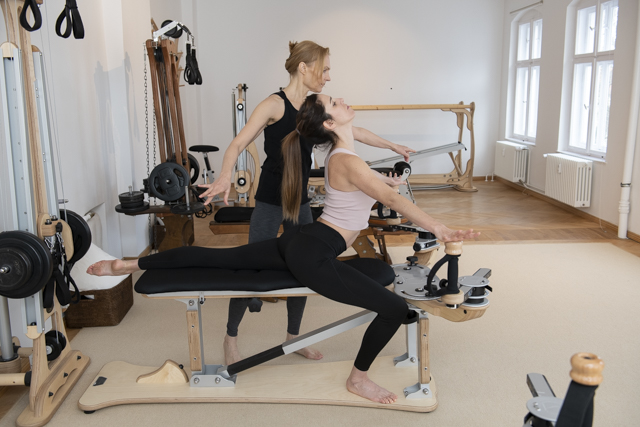
One might think that a discussion about opposition would start at the extremities reaching out in opposite directions, but it should actually begin in the center. “ In China they call it ‘dantian.’ In Japan they call it ‘hara.’ [Gyrotonic method founder] Juliu Horvath calls it the ‘seed center.’ It’s the energetic center of the pelvis,” explains Anke Hauerstein, a Martha Graham–trained dancer and Gyrotonic and Gyrokinesis master trainer. “And from that center, all oppositions are created.”
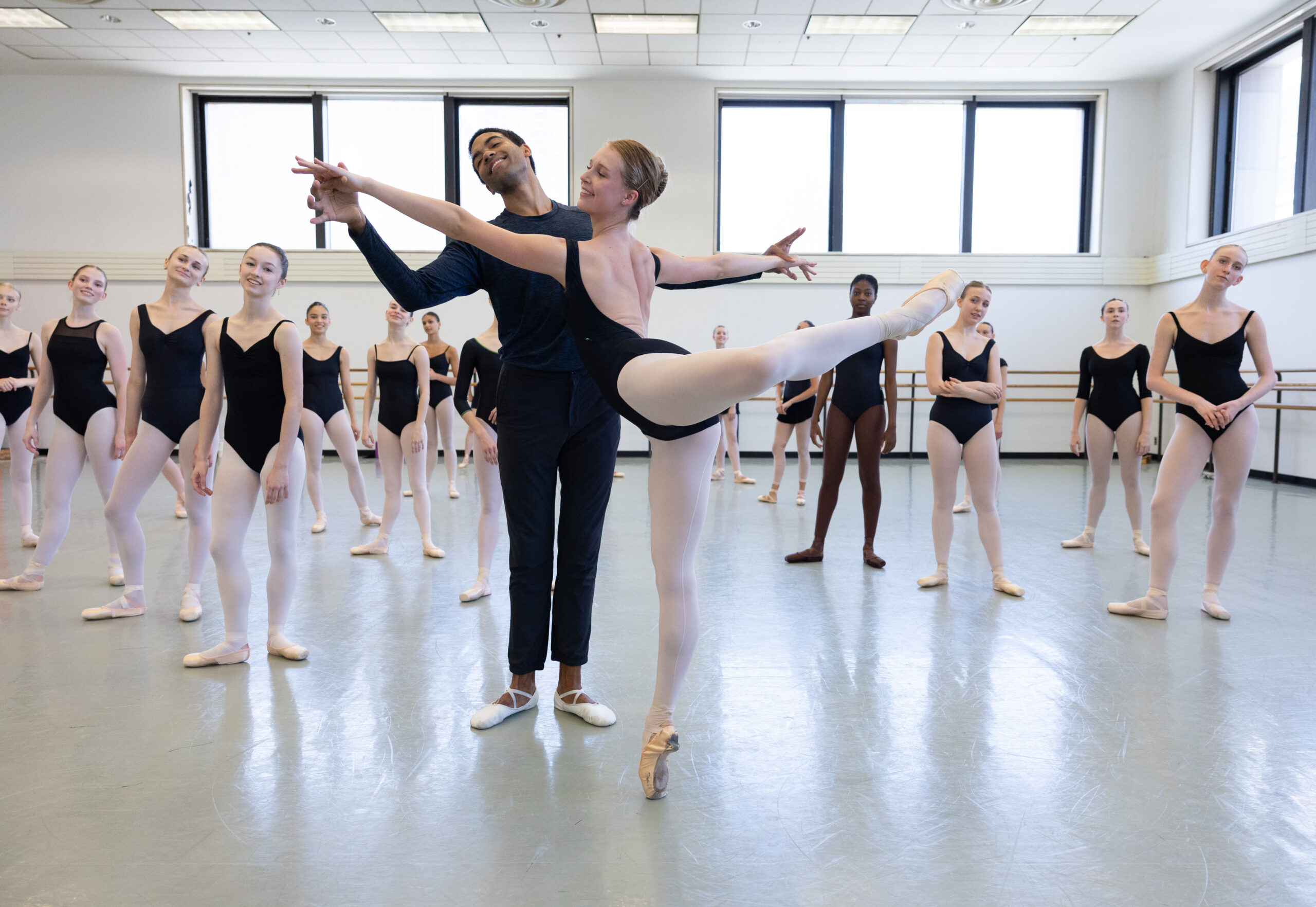
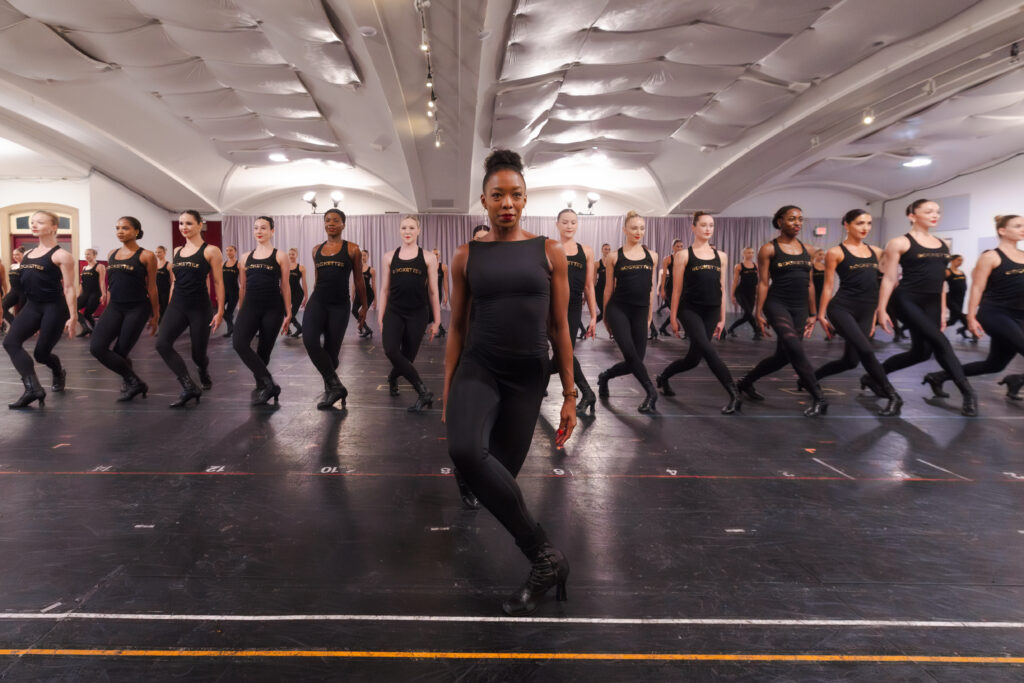
The concept’s prevalence in different cultures mirrors its universality across dance styles. Center-rooted opposition powers a ballet dancer’s strong standing leg in a renversé while their upper body sails in an effortless spiral; it enables dynamic isolations in a hard-hitting street style; it underpins the angles and precise synchronicity in a Rockette kick-line; and it can help your students strengthen their technique while unlocking new levels of expression.
Read on for tips from experts in a range of styles to help your students master this technical and artistic tool that will help them find stability, mobility, and artistry.
Use Metaphors
Oppositional concepts—lifting vs. groundedness, expansion vs. contraction, twisting vs. lengthening—can feel nebulous to verbalize. Radio City Rockette dancer, dance captain, and assistant choreographer Danelle Morgan says she needs to try something in her own body before coming up with different cues to translate that feeling into instruction. “It’s working to use my body and then being able to say things in 10 different ways so that we can get everybody on board.”
There’s no shortage of useful metaphors and imagery to describe opposition. Hauerstein notes that Gyrotonic’s “seed center” phrasing provides a useful visual reference: trees rooting strongly through their base and stretching skyward through their branches. Silas Farley, a former New York City Ballet dancer who is currently Southern Methodist University’s Armstrong Artist in Residence and assistant professor of ballet, uses a suite of vibrant visuals, some adapted from his lineage of teachers. “When the dancers would step into first arabesque, [Balanchine] would ask them ‘What do you like better—diamonds, ice cream, or money?’ Let’s say it was diamonds. ‘There are diamonds in front of that front arm. Reach to it. There are diamonds next to that back arm. Reach to it. There are diamonds down on the floor and where your back toe is.’ It’s as if the body is being expanded and pulled in opposing energies out from the center.” He also uses the image of a suspension bridge with cables pulling and stabilizing the center in all directions, or the limbs radiating energetically outwards like sun rays.
New York City–based choreographer and teacher Eric Delgado thinks of the torso as a piece of paper with the shoulders and hips as each corner. Rather than reaching the extremities (such as a hand or a foot) in opposite directions, have your students think of initiating the movement from the corners. “Think of pulling each corner first and then letting the arms be a product of that. Address the shoulder, then the elbow, then the forearm, then the wrist. Work from the center out,” he says.
Hauerstein suggests thinking of the body’s connections as strong, flexible spiderwebs; the strings of a circus tent pulling evenly for stability; or even imagining opposing energies as water: “ The seed center is like the ocean, and from the ocean, the little rivers run right through the center of the body, the center of the legs, the center of the arms out into space, and all this flows back into the ocean again.”
Fully Commit to the Movement
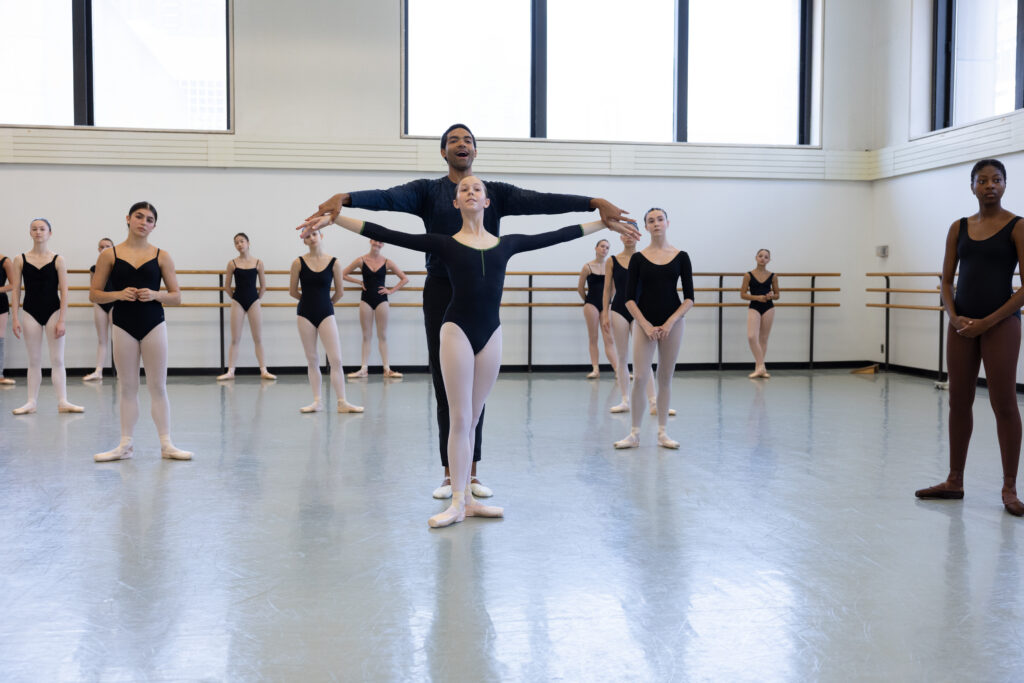
Opposition requires students to be committed, strong, and confident. Surface-level movements without center-rooted expansion can appear unstable or disjointed, says Farley. “When the dancer is timid or allowing the movement to collapse into the center without opposition, the movement becomes rickety,” he explains.
Delgado emphasizes the need for deep pliés. “Push through the ground, plié a little bit more. You want to put your hips into it versus just putting your weight down.” For example, they may stretch their arms in opposing directions without first thinking about extending outward from the center. “It doesn’t feel like there’s any form to it because there’s no resistance and there’s no opposition, no activation in the muscles. When you’re committed to the movement, when you understand it physically, there’s shape versus fragility.”
Opposition and expansion in space provide freedom, says Farley. “Big positions,” as he calls them, give his students “so much more mental legroom to live in the music, feel the connection to the other dancers, and all those things that translate it from just being a technical exercise into an expressive dance.”
Find Breath, Release Tension
Sometimes an opposing force is not a force at all, but a release. After all, a single muscle doesn’t engage in opposite directions, which would be anatomically impossible. To create textures in shape, some muscles contract while others lengthen. “A stiff board will snap, a noodle will disintegrate. You have to have some dynamic between that gathering energy and that releasing energy all the time,” says Farley.
In a studio full of hard-working Rockettes, Morgan will sometimes see their effort to ground and lengthen, stretch and plié, contract and arch tip over into tension. “It’s that idea of ‘ I need to balance, I need to hold on to this,’ and we lock into ourselves.” Even in a very engaged position like a passé relevé balance, she’ll tell them “Inhale, exhale,” she says, “just so that they can remind themselves to breathe and balance. And that actually does help them activate through their muscles.”
This can also help prevent overcorrection in any one direction. “ Sometimes it’s too much effort in the movements,” says Hauerstein. “If a student would fine-tune with less effort, this creates an inner balance, and the fine-tuning could be something which helps the student to develop the awareness in space. That can be up and down, in and out, into the diagonals. But the same effort in all directions is important.”
When dancers can find expansion, release, and centered strength, they can move more confidently and embody the dance, rather than just go through the motions. Farley remembers the moment it clicked for one of his students. “She was offering her cheekbone to the light in one direction; her leg was reaching in another direction, the standing leg pulling down to the floor; and it was as if I was holding her wrist up in the air in fifth. She had that sense of multidirectional suspension. She felt expressive, but she also felt solid. And I was like, ‘That’s gold.’ ”