How Daniel Duell Passes Along Balanchine’s Lessons on Musicality

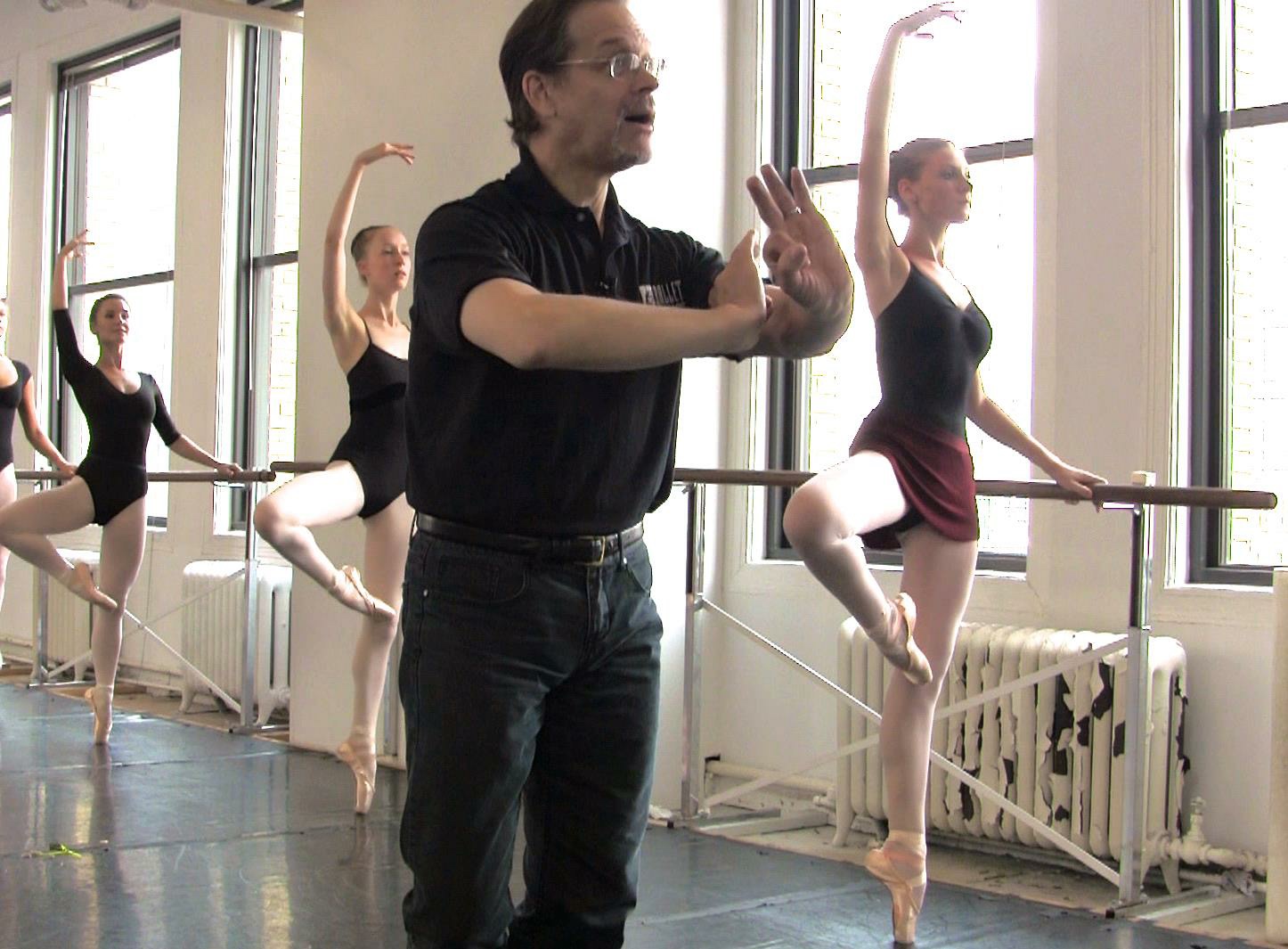
During his 15 years dancing for New York City Ballet—including 10 under George Balanchine himself—plus three years training with master teacher Stanley Williams at the School of American Ballet, Daniel Duell internalized a very specific approach to musicality.
“A central part of what I believe makes dancers appear musical is clarity of rhythm,” says Duell, now the artistic director of Ballet Chicago. “You move very precisely when a beat begins, not before or not after, but exactly on it, which means you have to be ready beforehand to move when that note hits.”
Drilling deeper, he teaches his students to think about dividing every step into multiple beats. For instance, instead of simply brushing out to a tendu on count one and closing back into fifth position on count two, “you would subdivide that time by half,” he says, explaining that he has students perform this movement in four parts: arrive in tendu, stay, close to fifth, stay. “That gives the eye a moment to actually see the tendu arrive, and it gives fifth position a visual moment, too,” he says. Of course, this strategy gets more challenging as the tempo gets faster, he acknowledges, but it always remains the goal.
Even with more legato movement, Duell coaches dancers to make sure that every step has a clear beginning, and that they show off the ending for a moment before proceeding along to the next position. “That helps define it visually to the viewer,” he says. For instance, although a port de bras might be designed to never stop moving through a piece of choreography, “you’d want to crystallize those positions—the high fifth, the allongé arabesque, say—within the flow of the phrase so it doesn’t look just shapeless. It has lyricism and stretch, but there’s still a clear shape to the movement,” he adds. That means the arms might never hit a moment of complete stillness, but they can still emphasize a particular moment by slowing way down so the audience has a moment to take it in.
Duell likes to have students tackle these kinds of challenges without too much help from the songs he chooses for class combinations. “Generally, I like music that is not so forceful that it supplies all the dancers’ energy for them, so to speak,” he says. One example: Rather than selecting a strong, heavily accented piece for grand allégro, he’ll choose something light and easy, like “Oh, What a Beautiful Mornin’.” This leaves it up to the dancer to bring the verve, giving off an even brighter energy to balance a more low-key tune.
Sometimes, when he’s working with a live pianist, Duell might even have them just play a few notes and instruct the dancers to keep moving between the notes that they hear. “And their task is to keep an even rhythm, even though they’re not hearing a note on every beat.” Or he might ask students to dance a syncopated phrase to music with a very even beat, or vice versa. “That’s another way of getting them more conscious of how they’re moving to—or between—the beat,” he explains.
More than anything, Duell wants to pass along a love and respect for music to his students, treating their relationship to it not as an afterthought but as their starting point. To underscore this, he shares a favorite anecdote: “All of us like good dance floors—good marleys, sprung wood, and all of those things. But, Mr. B said, ‘Music is the true floor on which we dance.’ ”
His Favorite Albums for Ballet Class
Although Duell typically works with a live accompanist at Ballet Chicago, he also has a few recorded albums he turns to regularly when needed.
Thank You, Mr. B, by Steven Mitchell
“This is composed of pieces from Mr. B’s repertory, but squared off at the ends and very usable for the number of eights you’d need for a class combination. For instance, he has slow tendus to Slaughter on Tenth Avenue. And dancers have great fun with it because they are so familiar with those ballets. They love dancing to them as class music.”
Music for Ballet Class, by Josu Gallastegui
“His music has a lot of dense Spanish flavor to it, in a variety of tempos. The Spanish traditions span a wide range from bolero to flamenco, and very haunting slower melodies. And they all have a very special flavor to them.”
More Lynn Stanford Music for Ballet Class, by Lynn Stanford
“If you want to just dance to music that you enjoy hearing, Lynn Stanford’s CDs for ballet class are terrific—they make you want to move. He was David Howard’s most frequent pianist, and he played a lot for Stanley Williams’ classes, as well. He was great with jazzy syncopated things, calypso—really bouncy tunes. He played a lot of high-energy music.”