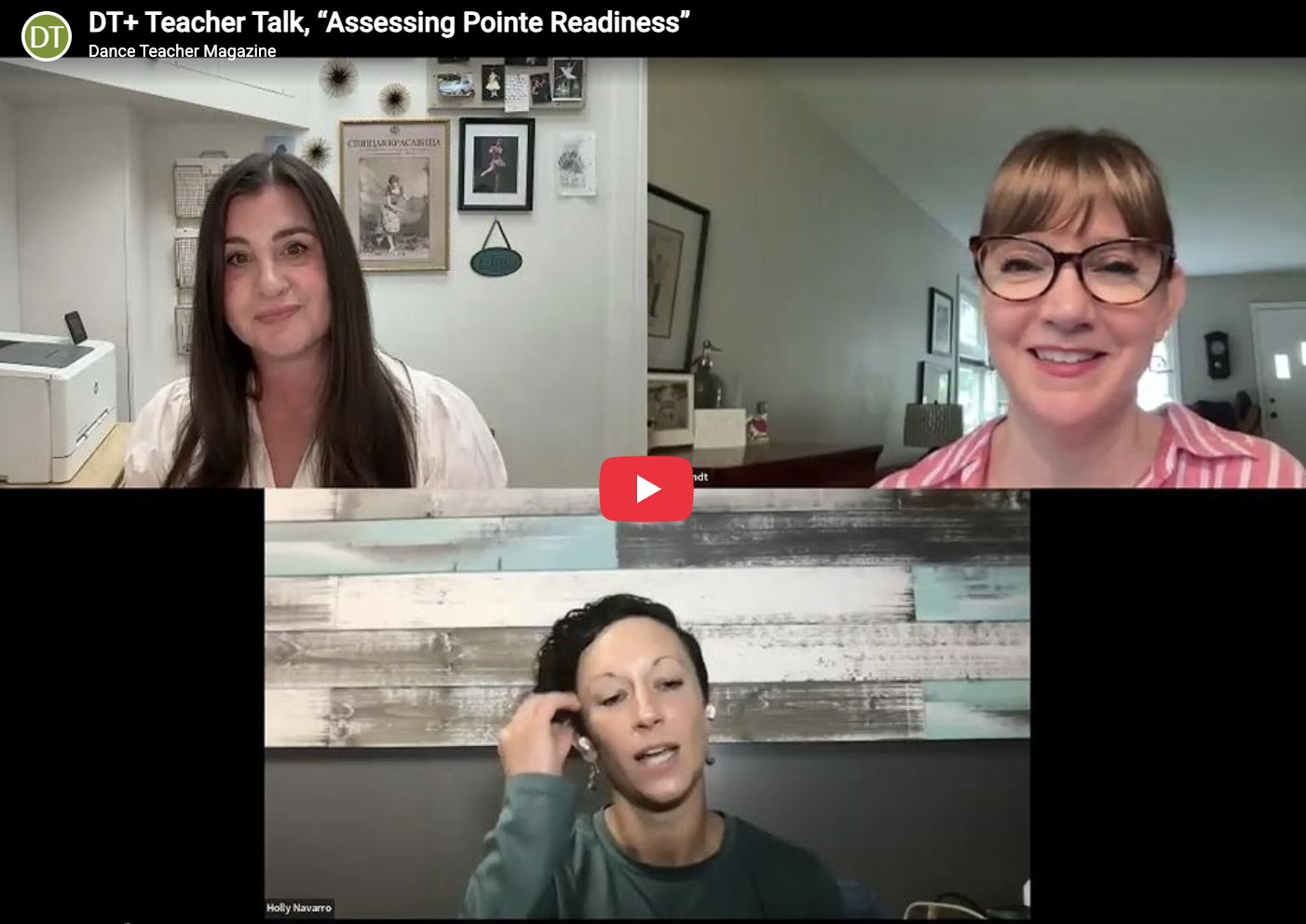
Watch DT+ Teacher Talk: “Assessing Pointe Readiness”

In this exclusive DT+ Teacher Talk, physical therapist, Holly Navarro, and pointe shoe fitter and retailer, Kristin Ruggieri, joins Dance Teacher‘s senior consulting editor and Pointe‘s editor-in-chief, Amy Brandt, to discuss the physical and technical benchmarks teachers should consider, red flags to watch for, and practical ways to prepare dancers for pointe.
Takeaways for Teachers
1. Pointe readiness is about more than creating a beautiful ballet line.
Assess strength, control, alignment, and maturity—not just artistry.
2. Build control before adding complexity.
Dancers should be able to consistently execute basic exercises with control before progressing to center work or pointe.
3. Endurance matters.
Evaluate whether dancers can maintain calf and ankle strength across multiple repetitions, rather than just perform one strong relevé.
4. Use objective assessments to support your judgment.
Tests such as single-leg relevés, the airplane test, and pencil test can provide useful information alongside your professional observation.
5. A flexible foot still needs to be a strong foot.
Mobility and range of motion are only beneficial when a dancer has the strength and control to support them.
6. Watch the ankles closely.
Sickling, poor ankle range, sinking, or floating above the platform can signal that a dancer needs more strength, control, or a different shoe.
7. Build pointe skills progressively.
Start with barre work and foundational relevé exercises before introducing more demanding movements—and save turns and jumps en pointe for later.
8. The pointe shoe should support the dancer, not compensate for weaknesses.
Shoe selection should account for foot shape, strength, mobility, alignment, and the dancer’s ability to get fully over the box.
9. Pain deserves attention.
While some toe discomfort can be expected when beginning pointe, persistent or significant pain is a reason to stop and investigate the cause.
10. “Not yet” should come with a plan.
If a dancer isn’t ready, identify the specific areas for improvement and set achievable milestones so they know what to work toward.