
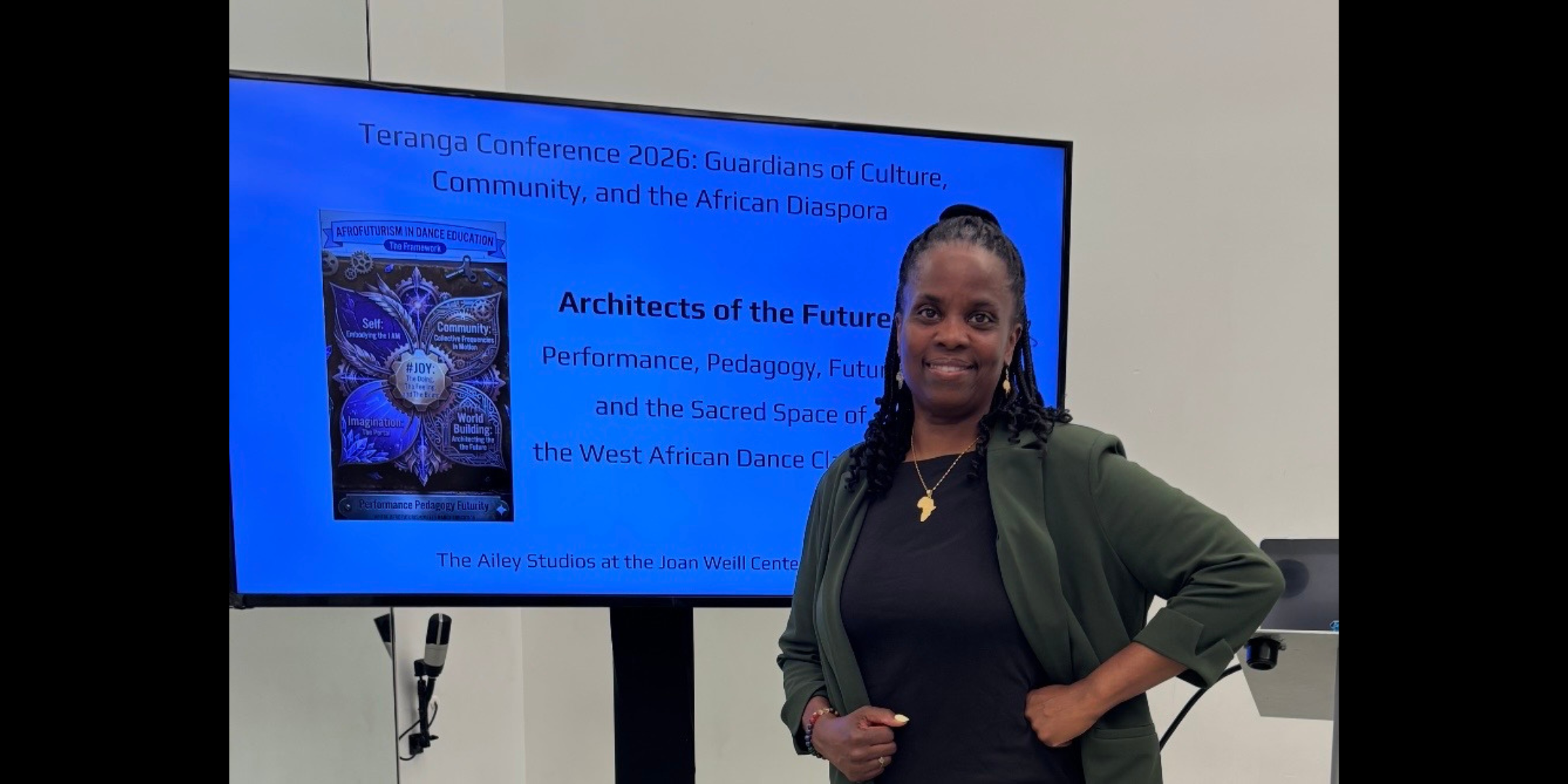
Office Hours With Dr. Andrea Markus

In her early 20s, Dr. Andrea Markus was training in the Cecchetti technique at the New York Theatre Ballet School, when her teacher, Diana Byer, asked if she wanted to assist a children’s class. “I fell in love with it,” she recalls. “The joy of being able to pass along something—that was the beginning.”
#JOY, as Dr. Markus, EdD, stylizes it, has become a cornerstone of a teaching career that has spanned appointments at college dance programs at New York University and Marymount Manhattan College, and teaching artist positions with Alvin Ailey Arts in Education, New York City Ballet, Dancewave, ArtsConnection, and the Misty Copeland Foundation’s BE BOLD Program.
Threaded throughout Markus’ work is an approach grounded in Africanist ways of knowing and belonging. These commitments converged in her doctoral research at Teachers College, Columbia University, where she focused on developing a joyful, Afrofuturistic framework for dance education.
Dance Teacher spoke with Markus about the science of joy, what Afrofuturism makes possible in the classroom, and her pedagogical vision for honoring the whole human.
What makes a dance class truly successful—for both the students and the teacher?
A truly successful dance class is one where the exchange runs both ways. I’m not just delivering content—the students and I are co-creating something together, rooted in the ubuntu idea of “I am because we are.”
What have you found most rewarding about supporting today’s generation of dancers?
Witnessing [preK–12] teachers see students in a different light. They know their students, they love their students. Sometimes, though, it’s in the dance classroom where a student who might be struggling in other ways can show their ability to listen, learn, and respond. That doesn’t get old for me. To watch a teacher’s eyes widen and then be surprised—I love that. And I love that I get to be a part of a community that pours into young people.
What has been most challenging?
It’s frustrating to continually see the lack of knowledge about what arts education can do. The music lobby is strong, so most schools have music programs. Theater and dance—I feel like students are lucky if they get it.
Do you have a role model in the dance education field?
Diana Byer is up there for me. I came to her as an older learner, but she saw that I wanted to teach, and she didn’t hesitate. She pushed me, and she believed I could do it. I also took a trip to West Africa where, in Guinea, Bangaly Bangoura taught me many things.
Your research draws on Afrofuturism as a way of imagining and enacting new possibilities in dance education. What does Afrofuturism mean for you?
Listening to stories of like-minded Black women dance educators for my doctoral research, I found that we’re teaching with care, love, and mentorship. Oftentimes, that throughline came back to our past, who mentored us, where we are now, and our vision for the future—and it was totally Afrofuturism: Black people’s relationship with the past, present, future, science, technology, all in one. It’s about co-creating this beautiful future.
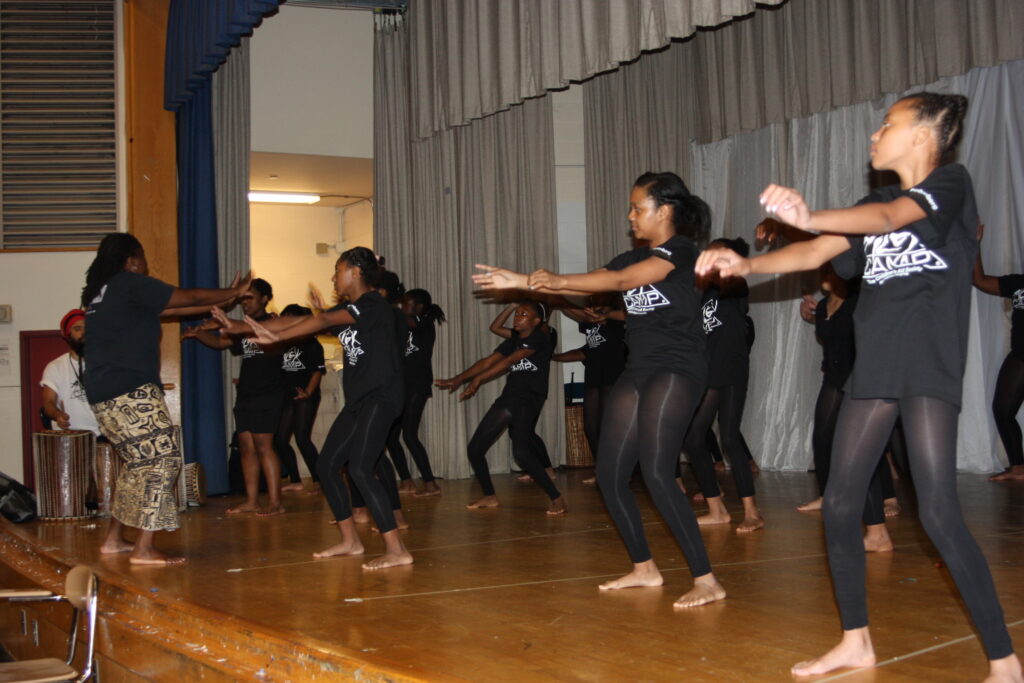
#JOY is also a central part of your pedagogy. Why is joy so important to your teaching, and what does it look like in practice?
When I was in graduate school, I heard one of my colleagues talk about joy. I thought, Why can’t learning be joyful? I decided I’m not going to run from joy—let’s center it, because if there’s no joy in the classroom, students aren’t going to retain what we’re teaching.
One of my lessons, I call “The Science of Joy,” or my radical joy praxis. I focus on the four happiness chemicals: dopamine, serotonin, oxytocin, endorphins. People love to say dance is fun, but I think students should understand why, so they can figure out how to tap into happiness for themselves. In the dance class, we can harness it all.
These ideas are now taking shape in the Performance, Pedagogy, Futurity framework you’re developing. What do you hope that work might make possible for dance educators?
The framework is for the whole human. It’s a holistic approach that asks: What are the things I’m saying to students as we’re moving? What are the activities we’re doing that train their choreography, their technique, and their human selves? It’s about community, joy in the class, imagination—even in a technique class—world-building and envisioning their futures. Students can transfer that to their lives, too, whether or not they’re going to be professional artists.
One of the things I say to students, especially in the conservatory, is: “Are you an artist or a piece of art?” I want to encourage them to take ownership. But it’s also this idea of “Who are you and whose are you? Who are your people that you can lean on?”
Where do you see the greatest opportunities for growth in dance education right now?
There needs to be a lot more culturally responsive work, focusing on who the students in the room are and how we co-create learning experiences. If a teacher does not reflect the community they’re serving, we can’t assume they’re automatically prepared to teach in that context. Some organizations do not do enough anti-Black work with their teaching artists, and we can harm students if we don’t do that work.
What message would you like to leave with today’s dance educators?
Continue doing work on the self, and remember who you are and what you’re doing here.
Dr. Markus’ Reading List
Inspired by Andrea Markus’ call for educators to “continue doing work on the self,” here are the books and articles she recommends for teachers interested in Afrofuturism, culturally responsive pedagogy, and joyful learning:
- Afrofuturism: The World of Black Sci-Fi and Fantasy Culture, by Ytasha L. Womack
- Archaeology of Self: The Introspective Educator’s Guide to Racial Literacy, by Yolanda Sealey-Ruiz
- “Future Echoes of the Continuous Quest for Afrofuturism in Dance Education,” by Andrea K. Markus, EdD (NDEO Blog)
- “Love in Motion: Dance Education, bell hooks, and the Power of Community,” by Andrea K. Markus, EdD, and Regina Fergerson
- The Spirit of Our Work: Black Women Teachers (Re)member, by Cynthia B. Dillard


