
How to Integrate Injured Students Into Class

When professional dancer Haylee Nichele was earning her BFA at The Juilliard School, she tore a muscle in the bottom of her foot. She was unable to walk, so dancing was out of the question. Instead of simply sitting on the sidelines, Nichele says she learned to look at dance in a different way while healing.
“When I finally got back into class, I felt stronger, which was wild,” she remembers. “I’ve been thinking about what was so helpful about how I handled that injury—taking notes throughout class, and actively watching through the lens of my anatomy training, how the teacher is giving corrections, and which students are capturing the dynamics of the work.”
Injury is disappointing and difficult for dancers, but it can also be an important growth opportunity. By approaching injury mindfully, fostering class participation, and highlighting progress over perfection, teachers can set the tone for students’ continued development.
A Shift in Perspective
Just like Nichele experienced, a perspective shift prompted by an injury can be a powerful tool. Teachers can jumpstart this process by offering structured ways for students to observe and adjusting curriculums as needed.
Nichele, who is also an educator, recalls how she successfully helped one of her high school dance students who was healing from a severe injury. “I adapted my curriculum so that we could discuss and explore ideas of Cunningham-esque chance operations,” Nichele explains. “This person that was injured could basically do every single part of it, and then we just paired her with another dancer that could physicalize everything she developed.”
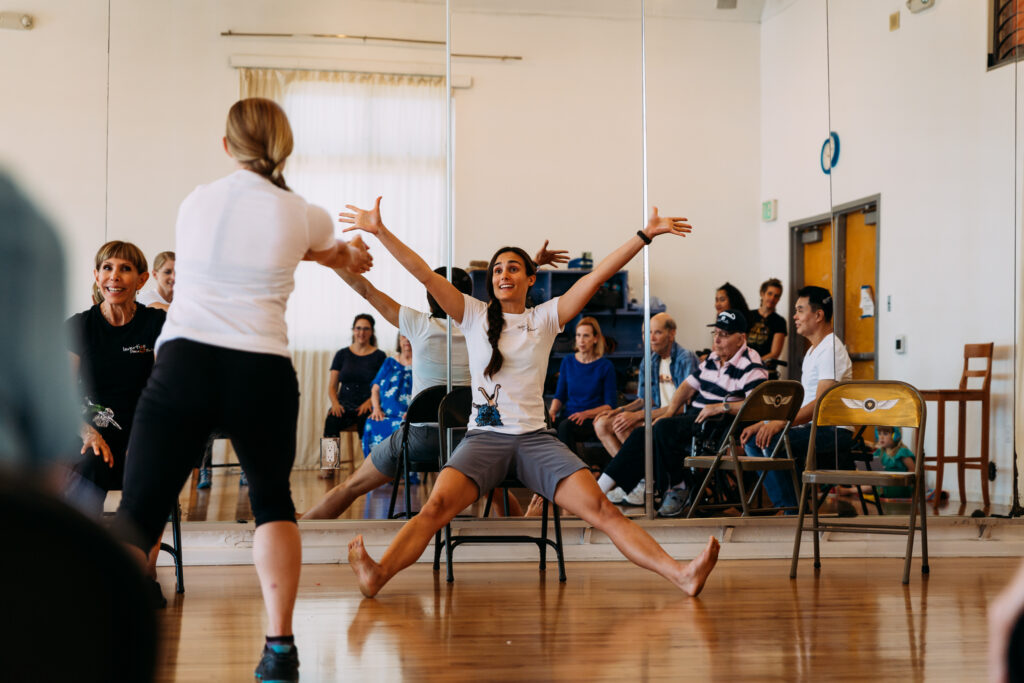
Nichele also recommends, depending on the maturity level of students, placing the injured student in the role of teacher by involving them in the correction process at the end of an exercise or run of repertory. “Ask them, ‘Are you seeing these things too? Did I miss anything? What do you see?’ ”
Giving students helpful tasks around the studio related to performance or production, like filming choreography or being in charge of music for class, can also help them feel valued. “Sitting there with your TheraBand can only occupy you for so long,” says Kristen Mackel, a licensed clinical social worker who specializes in working with athletes and creatives. “To give them a meaningful contribution to class helps them feel like they are still a member of the studio.”
Mindful Modifications

Oftentimes, depending on the severity of the injury, students may be able to participate in some exercises, but not others. Teachers can help students develop movement modifications so they can stay as physically active as possible in a way that doesn’t sacrifice technique, says Megan Meier, MD, a dance medicine specialist.
Open communication with the student about what hurts and what doesn’t is important, she says. From there, teachers can begin to limit specific exercises. “If we’re talking about a hip impingement or snapping hip, maybe grand battement is bothersome,” she says. “I’ll tell students to limit how much they’re doing it, or keep that leg at a lower level.”
Meier also says that exercises like floor barre, which take weight off the lower body, can be a helpful way for students to stay physically involved in a more specific way while nursing an injury. Marking the choreography with the hands and upper body can also be helpful, especially when paired with visualization techniques. “There’s a lot that has been studied with visualization in sports specifically,” Meier says. “It activates the same areas of the brain as actively doing the skill.”
Throughout the injury, teachers should stay mindful of when to encourage students to seek the support of a medical professional. “If a dancer is compensating in some way, and the instructor is noticing technique is taking a hit, or if the dancer is obviously in pain, I would encourage evaluation early and often,” Meier says.
Safe Reintegration
When it comes time for injured students to titrate up to full participation, it’s especially important to heed the advice of medical professionals—but teachers also play an important role in the pace and sustainability of this process. “For dance teachers, I would almost look at it as ‘How would we build a skill if they were just learning to dance?’ ” Meier says. Implementing a simple “green, yellow, red” model can be helpful. Green represents no pain, yellow signifies some soreness and encourages caution, and red indicates progressive pain and necessitates a pause or stop from the specific motion.

Leigh Skvarla, PhD, LPC, Mackel’s business partner, urges teachers to clearly communicate timelines to dancers so they can know what to expect when it comes to healing times, how they’ll be expected to participate in class at each stage of rehabilitation, and if they can expect to be recast in any upcoming performances. This type of clarity can ease injury-related anxiety, she explains.
Verbal recognition of progress can also have a big impact when a student is returning from an injury. “It’s important for dance teachers to highlight what the dancer was able to accomplish when they weren’t in the studio space,” Skvarla says, adding that noting things like establishing care with a physical therapist, reading a book on mental performance, and simply working on PT exercises and making progress will have a big effect on a student’s confidence and attitude. “We can take each little compliment, each little observation, each little win, to scaffold that learning and improvement.”


