Juilliard’s Melissa Toogood Explores Timing, Adaptability, and Collaboration Through Music

Timing is everything for Melissa Toogood, the dean and director of Juilliard’s dance division. Toogood tells Dance Teacher that accountability to timing, yet the flexibility and adaptability to make creative choices, are important qualities she emphasizes with dancers—and something she’s on the lookout for when auditioning prospective students.
“Are they making choices about how they’re doing pliés, or are they just going through the motions?” Toogood observes. “Musicality is super-important in terms of technically achieving something, and also artistically. They really go hand in hand.”
It’s an approach to sound and movement that Toogood says has been influenced by Merce Cunningham, with whom Toogood danced during the famous choreographer’s final years. Toogood is now an official stager for the Merce Cunningham Trust, and teacher of the Cunningham technique.
“He didn’t talk a lot about the relationship to music. He purposely separated it. But he talked a lot about time,” Toogood says of Cunningham. “If he changed the size of a step, he would say things like, ‘Don’t equate space with time. Just because I asked you to [do it] bigger doesn’t mean you get more time to do it. You still have to do it as fast or as slow, depending on the step.’ ”
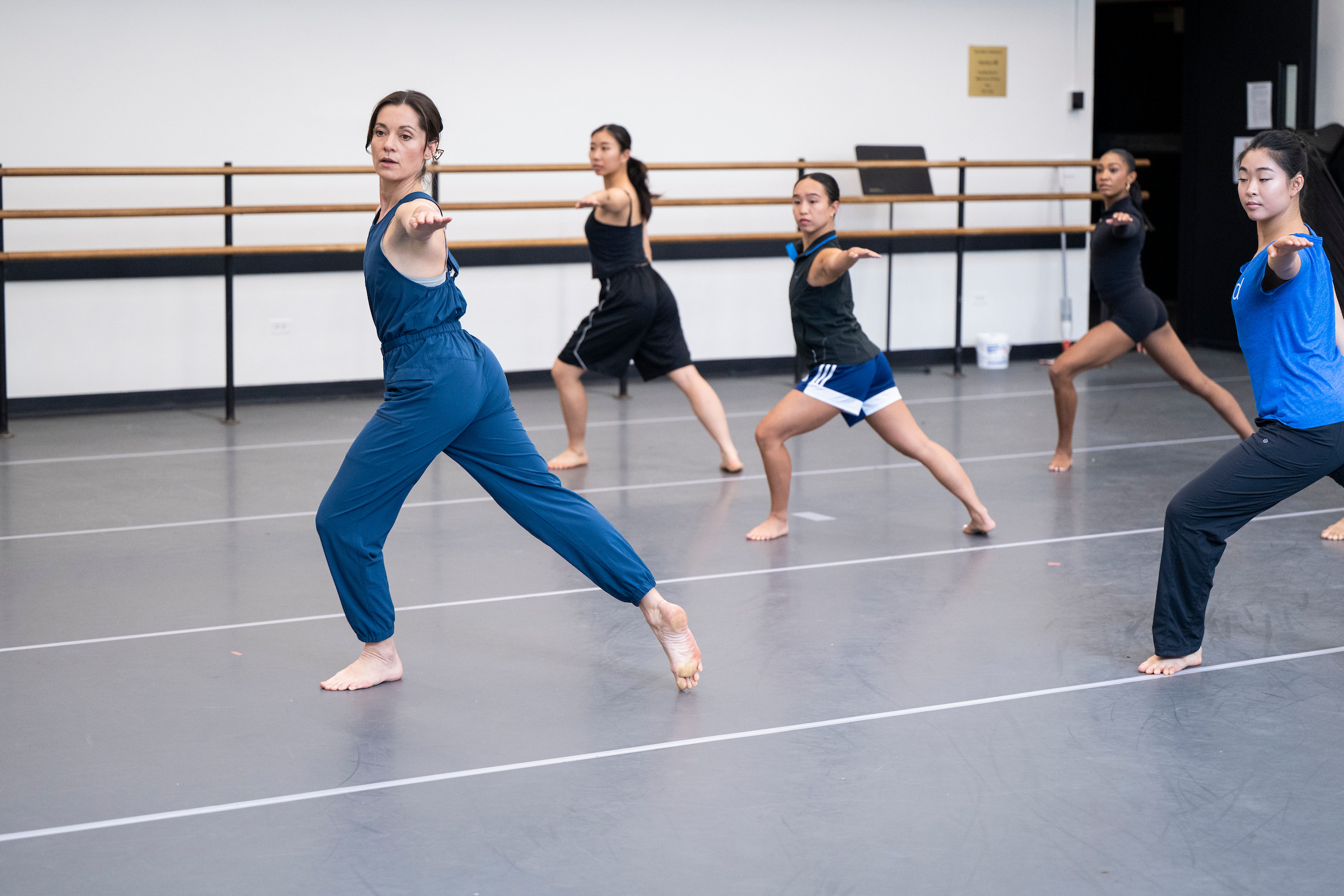
She’s been busy both in and outside the studio since taking over as head of Juilliard’s dance department last year, but when she is in the classroom Toogood likes to give exercises with very clear timing, enabling the dancers to play and have the freedom to create within those parameters.
“I like to give combinations where I’m like, ‘Okay, we just did this phrase, and it’s two eighths. Now, I want you to do the same thing, but make it work in three eighths.’ Then they have to be really aware of how much time they have, and to make choices,” Toogood says. “So the accountability to time isn’t rigid. It’s just that they’re aware.”
Another skill Toogood wants dance students to take away from their time at Juilliard is the ability to work well with and be inspired by musicians and other artists. That means not only being flexible and adaptable enough to dance to live accompaniment, but also fostering artistic relationships with peers in the Juilliard music department and beyond.
“Bringing in artists that maybe aren’t on their radar that really [make them] think about the relationship they have with other artists—whether it be musicians, visual artists, dramaturgs—that’s important to me,” she says.
Toogood encourages cross-disciplinary collaboration and working with live music whenever possible, including in student-led works and the school’s choreographic workshops. She points out that for a lot of her students, these classes and performances at Juilliard are their very first time dancing with live music. It’s an introduction to what she hopes will be a continuous learning experience—and a facet of the art they’ll continue to explore long after they graduate.
“Every show is going to be a little different,” Toogood says of dancing to live music. “So making sure they really have the experience of what that’s like, and that it doesn’t fluster them, and that they can be excited about that live element—that’s something that can add to their performance.”
Melissa Toogood’s Favorite Songs for Dance Class
Toogood unequivocally prefers having live music accompaniment during class. But if she absolutely must use recorded music, she gets inspired by digging through playlists compiled by her husband: a visual artist from Austin, Texas, who has a lot of musician friends. Her own music tastes vary from folk and pop music to rock and bluegrass.
“To be honest, I don’t create playlists very often, but usually it’s just a mix of music that I’ve been listening to, and then I make a combination that works with that,” Toogood says.
Part of what she loves about live music accompaniment for class is “the surprise aspect of it” and never knowing what song, style, or even instrument the musician will play next, so she sometimes finds ways to incorporate that element of surprise in class playlists, too.
“Sometimes I use chance,” Toogood says of her playlist curation. “I just shuffle and see what comes up.”
“Extraordinary Machine,” by Fiona Apple
“I use this for tendus,” Toogood says. “I think it has a clear beat, but then there’s unexpected dings and sounds that come. It’s clear and unexpected.”
“Tonight We Fly,” by L.C. Franke
Toogood loves the “old-school crooner kind of vibe” and “uplifting” energy in L.C. Franke’s cover of “Tonight We Fly.”
“It’s very dense in terms of sound,” Toogood says. “It’s going nonstop, so you can either really listen to all the little beats, or just go with one.”