What to Know About Teaching Dance During Perimenopause and Menopause

In a dance world that has historically placed a great deal of importance on the type of virtuosity that comes with youth, the idea of perimenopause and menopause might feel overwhelming. “For dancers and dance teachers, there’s a lot of our identity wrapped up in the physical,” says Carolyne Anthony, a dance educator, somatic practitioner, and founder of the female-focused movement program The Carolyne Anthony Method. “When things start to change during perimenopause, it’s very difficult to come to terms with some of the changes.”
While your body—and therefore your teaching practice—will undoubtedly experience these changes, it’s possible to meet this moment with grace, embracing the shifts that come using a mix of practical measures and mindset adjustments. “It does you well to be educated regarding these changes, accommodate them, and become resilient to them,” Anthony says. “That’s going to set you up for this next phase.”
What to Expect

Perimenopause and menopause are two distinct stages in a woman’s life, Anthony explains. Perimenopause refers to the time leading up to a woman’s final menstrual cycle, when the hormones estrogen and progesterone naturally begin to decrease (usually as early as mid-30s to late 40s). Menopause is the time when menstrual cycles completely stop.
According to Kelly Tipton, MD, an OB-GYN and a former Atlanta Ballet dancer, this time of life can bring about changes in temperature regulation, like hot flashes and night sweats, as well as weight fluctuations. Menopause-related hormone shifts will also cause changes in the vaginal and vulvar area, making it more sensitive and prone to infection.
Anthony adds that decreasing estrogen will also affect your myofascial system, which can cause more stiffness and pain. “Estrogen creates a lot of elasticity throughout your body,” she says, “so when you start to lose it you are going to stiffen up.”
Women also might notice mental and emotional differences, like an increase in anxiety. Changes to sleep patterns are also common, Anthony says, which can contribute to a feeling of brain fog.
Adapting to Change
These changes may feel daunting, but there are practical steps dance teachers can take to manage each of them. Tipton recommends first returning to the basics of well-being: exercise, sleep, stress management, and eating well. “During this period, we see a lot of women circle back to the big staples that keep your mind and body healthy,” she says. “I know that those seem so basic, but a lot of women start to really focus on those things again because they are foundational assets.” It’s also important to talk with your doctor about hormonal and nonhormonal therapies that can target your specific symptoms.
Next, it might be necessary to reevaluate your clothing choices. Typical dancewear, like leggings and tights, can often be made from synthetic, nonbreathable fabric that keeps moisture trapped, which can irritate the vaginal area. “Wearing looser-fitting clothing with cotton underwear and then changing in between classes is a really great way to go,” Tipton says. For those experiencing hot flashes, dressing in layers can be an easy way to mitigate discomfort while teaching.
Anthony recommends also taking stock of your teaching practice. If you’re feeling more fatigued than you’re used to, it’s okay to mark movements or take breaks from demonstrating. She urges teachers to remember that recovery time increases as bodies change during menopause, so be mindful of building in extra rehabilitation time, and take extra care with warm-ups, cooldowns, and stretching.
“Have one of your students in the class do the demonstration for you. Talk a little bit more. Take some breaks. Sit down and teach,” Anthony says. “There’s nothing wrong with that.”
Continuing to Thrive
According to Tipton, dance is an ideal form of exercise for women in this phase of life, not only because it helps with flexibility and balance, but because it can help maintain bone health as bone density starts to naturally decline. “You’re getting in those small jumps, and you’re using your own weight as weight-bearing exercise, so that’s a huge benefit for dancers and dance teachers,” she says.
And not only is dance beneficial during menopause, this time of life can also bring new perspectives that can enrich your experience in the studio. Sarah Crowell, the artistic director of Dance Mission Theater in San Francisco, says that, as she went through perimenopause, her work grew and changed along with her body.
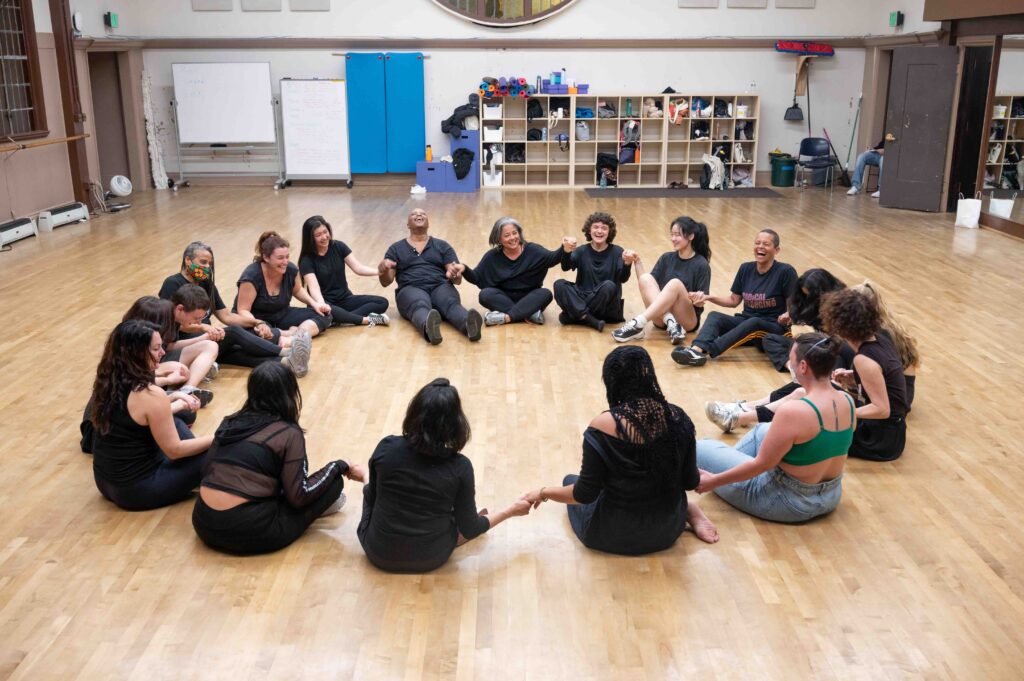
“I was sweating from effort, and I was sweating from hot flashes,” she remembers. “It was super-fascinating, and it helped me feel more present and very embodied.” She adds that she also felt a deepening of her artistic and teaching practice during this time, which she believes allowed her to listen more attentively—especially to her teenage students, who were also going through bodily changes of their own.
“I was able to really have more empathy and connection with my students,” says Crowell. “I was more present and available to them because I was more available to myself.”