
Philadelphia’s Second Chance Dance Creates Community for Adult Dancers

On a Monday morning at Second Chance Dance studio (SCD) in Philadelphia, a group of dancers takes ballet class in a sunlit space. They greet each other, stretch, and follow their instructor through a familiar warm-up. As class progresses, they watch a pirouette technique demonstration and power through a high-energy combination across the floor. What sets this class apart from others is that the students are all older adults.
Alyssa Bowser, owner and founder of Second Chance Dance, has been dancing in Philadelphia since age 2. She trained in tap, ballet, modern, jazz, and African dance throughout her adolescence before attending Arcadia University to study international business and culture, and French. After college, Bowser kept her connection to dance alive through teaching and directing at local studios, but she felt something was missing. “I felt like the generation of students was changing in their work ethic and how they committed,” she says. “I wasn’t getting the same fulfillment from teaching that [I felt as] a student.”

Bowser had never considered teaching adults until an acquaintance approached her at a cookout and asked to learn from her. When Bowser teaches, she’s serious about fundamentals, technique, and vocabulary. “You’re gonna learn definitions and positions,” she says. Bowser doubted that adults would be open to her intensive training style, but she agreed to teach a class. After that, her group of students grew consistently, and soon she was struggling to keep up with demand.
Six years later, Bowser is the owner of Second Chance Dance. The studio offers ballet, modern, jazz, tap, hip hop, African dance, praise dance, and more, to roughly 200 students per month. People travel from around the country to attend class and appreciate the space Bowser has created. Her dancers also take part in a yearly recital at the same theater she performed in as a child. As SCD grew, Bowser began to receive interest from dancers ages 55 and up. In response, she created her Golden Grace classes, tailored specifically to their needs in 2025.
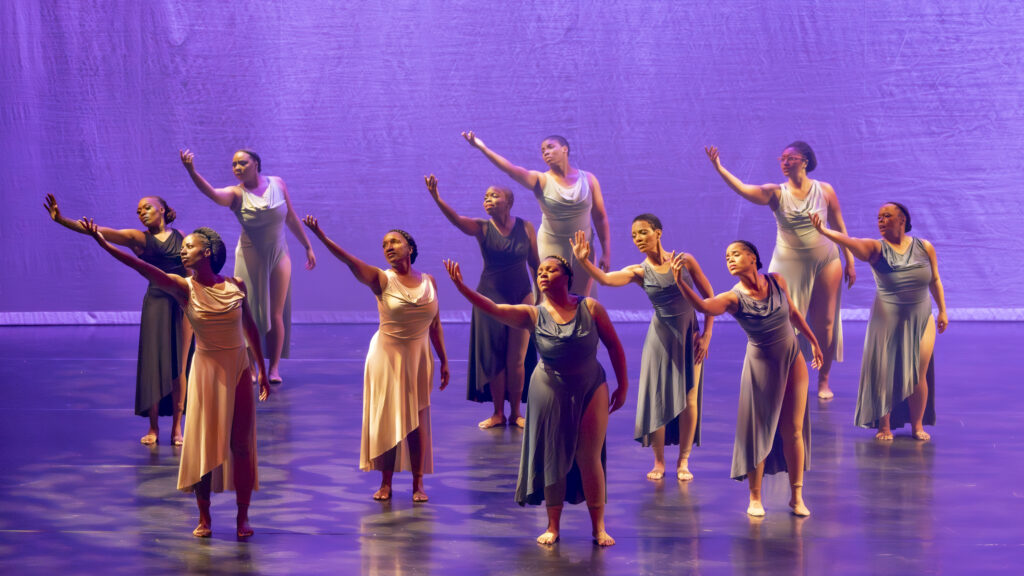
Key differences set SCD’s Golden Grace classes apart, starting with a slower pace of instruction. “I’m not as focused on growth based on their pace as I’m focused on retention, cleanliness, and consistency,” says Bowser. “If they need to restart [the combination] six times, we will restart six times.” Golden Grace classes are also more collaborative—she lets the students suggest music to add to the class playlist. (In their Monday class, they traveled across the floor to Earth, Wind, and Fire.) Bowser also teaches with strength and balance differences in mind, focusing on exercises that build her older students’ muscles. “I’m trying to make sure that they have support physically and anatomically so that they can continue to take classes,” she says. Other small tweaks include keeping the studio warmer, using a microphone to teach, sourcing modest recital costumes, and offering payment options that Golden Grace students are comfortable with.
Bowser approaches teaching adults with nuance. Being an adult beginner is a vulnerable experience that often requires unlearning. “You’ve learned that to gain respect, you’ve got to be the best from the beginning.…That’s hard to get an adult out of,” says Bowser. She reminds her dancers that their best is enough, however it looks on a given day. Her students’ relationships with each other are also important to their success in class, so Bowser cultivates a studio culture of support and encouragement. “When someone walks in, you’re going to hear a ‘Hey, lovely,’ ” she says, adding, “At this point, I don’t even have to ask [a veteran student] sitting in the lobby to walk someone new around the school.”
SCD’s impact is clear. “There’s something about succeeding in dance that makes you want to succeed in life,” says Bowser. “I’ve seen so many women gain confidence and learn to love themselves.” One Golden Grace dancer, Tara Bligen, says SCD provided her the opportunity to prioritize herself and her creativity. Bligen quit dance as a child and later came to regret it. She eventually returned, but she felt she’d missed out on developing her technique. “I couldn’t speak the language [of dance],” says Bligen. When she started beginner ballet at SCD, her outlook changed. “Certain things just woke up again,” she says. Now going on her second year at SCD, Bligen says she’s becoming fluent in the language of ballet, one of many class styles she takes.
In the future, Bowser plans to make her classes more accessible by streaming them online. She also wants to start a training program for dance teachers interested in teaching adults. “Finding teachers that can work with adults is harder than finding teachers who can work with kids,” she says. “You have to meet them where they are.” Bowser plans to expand SCD’s partnerships within the community and beyond. “I would love to partner with bigger organizations and start to shift the needle.”
Bowser hopes that SCD influences the dance world to appreciate the dancers who don’t meet its typical standards. “I would love for the community to look at these adults who didn’t start at 6 [years old], who don’t have the most beautiful hyperextension and the most deeply arched feet, and say that they are still dancers.”