
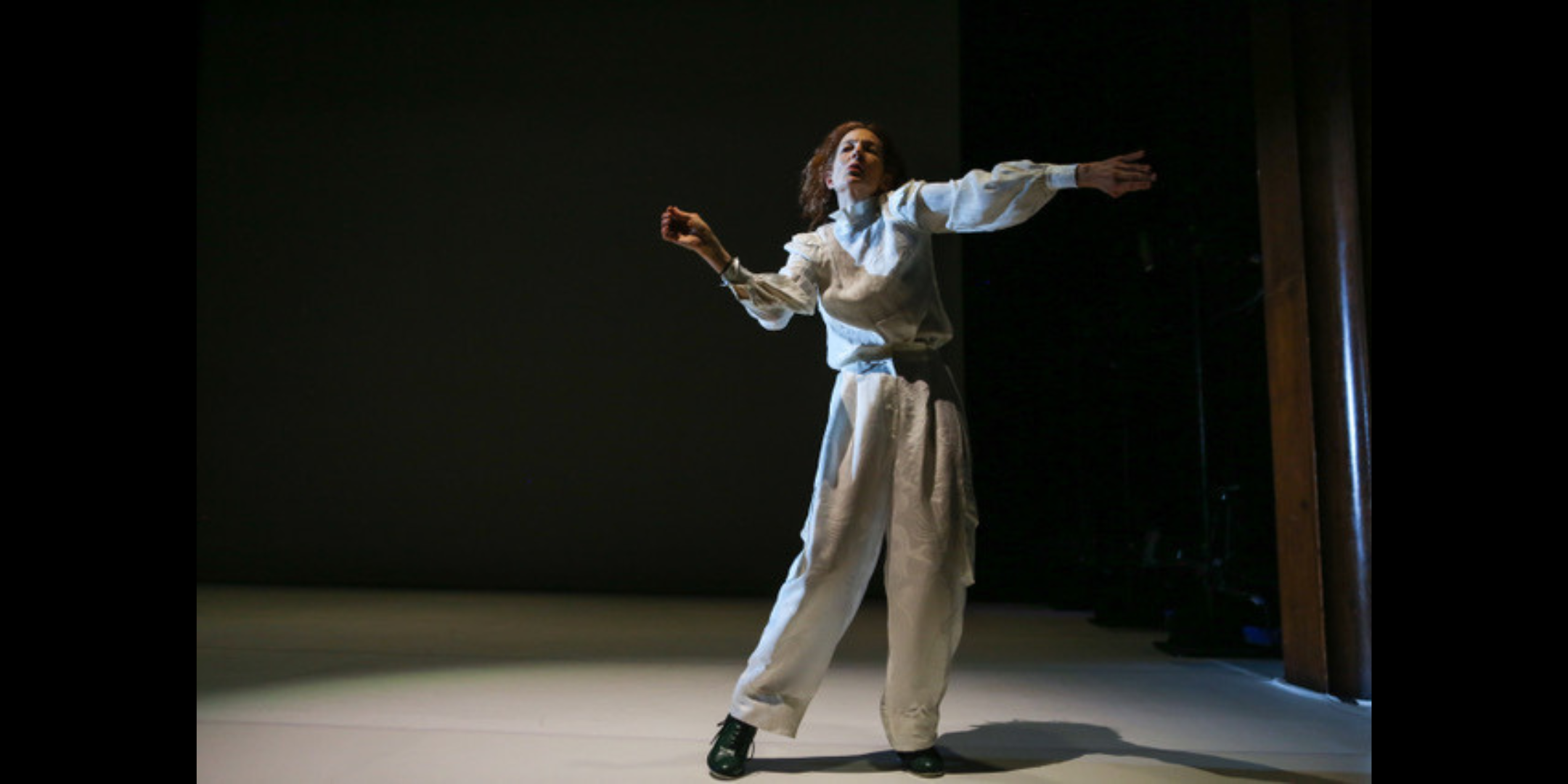
For Jodi Melnick, Movement Always Takes Precedence Over Music

Jodi Melnick loves music, but unlike a lot of choreographers, she doesn’t need music. For Melnick, a dancer and choreographer who has been a staple in the postmodern dance world for decades, movement “always, always, always” comes first—sometimes at the expense of using music or sound at all.
“I’m constantly making material, making movement, and it’s not because there’s sound on,” Melnick tells Dance Teacher. “I’ve never heard a piece of music and said, ‘Oh, my god, I want to choreograph to that.’ ”
That’s not to say that Melnick doesn’t create compelling performances with music accompaniment. While much of her choreographic process involves little or no music, she does team up with music and sound designers, like James Lo (a frequent collaborator), for works such as Superbloom (Dancing Into Choreographic Forms), which recently premiered at 92NY (the 92nd Street Y, New York). After creating the movement, she trusts intuition to know when incorporating a music or sound component could complement the choreography.
“I want it to coalesce into one experience,” Melnick explains. “I want the music, the composition, the sound score to bolster and be part of what I’m making. And it eventually does become part of what I’m making—but [the movement] could be on its own.”
At the start of an idea, Melnick doesn’t want the music to distract from the movement, or for the music to dictate what the movement should be. Music has a tendency to influence the listener emotionally; or to relay a specific storyline or narrative, something that she isn’t particularly interested in choreographically. It can also influence how the body feels compelled to move, something that Melnick actively rebels against.
She is, however, interested in what may happen when music is introduced. “When you put on a Madonna song from the ’80s, you’re going to bop. It’s going to tell you what to do,” Melnick explains. “That’s the magnificent thing about music, [but] I don’t want to be told what to do choreographically until I get started with my body.”
Still, music and sound do play a role in the movement and choreography classes that she teaches in New York City at Barnard College, where she’s been an adjunct professor since 2008. For her more advanced students, Melnick wants the body’s inner rhythm and musicality to lead the way. Then, the music comes in as a secondary element, as a way to help loosen things up in class, or to help dancers get out of their heads and into their bodies.
And for newer dancers, Melnick says music can be a valuable teaching assistant. “When I’m teaching more of a beginner class, I feel like musicality and rhythm from the music is a teaching tool that they can attach to, to help them learn about their body.”
Melnick notes that she’ll often start off the semester by teaching the movement on specific counts, giving the students an opportunity to get the choreography into their bodies before “opening it up.” Then, she’ll take away the music and challenge the students to find the movement on their own without relying on an external rhythm: “We know where your leg is on the 3, 4, or 5, 6, 7, 8. But if you take that away, what do you carry in your body rhythmically, musically, without that?”
When she wants students to really home in on a movement, such as the mechanics of a plié, without getting distracted by a catchy song, she’ll sometimes put on an unconventional soundtrack: Wind sounds (“strong winds,” preferably), crackling-fire noises, the sound of a flag waving in the breeze, and even the natural din of people having a backyard barbecue (“not right next door to you, but a couple doors down”) are all fair game for class accompaniment. “I mean, it’s really weird, I know,” Melnick comments. “It just feels comforting without feeling invasive or telling me what to do in the studio.”
If dancers or dance educators want to take a page out of her avant-garde handbook, Melnick suggests having music or sound on for support in the background, but always keeping the body and movement at the forefront. “Spend time examining what is really happening in the body, what is really happening when you bend or when you engage a muscle,” Melnick says, “and don’t let the excitement of an incredible song overtake that!”
Melnick’s Favorite Songs and Sounds for Dance Class
Melnick describes her music taste as being all over the place. “I don’t think anything is off limits for me,” she says. While she may have a certain purpose in mind for some songs on her playlist, a lot of them are interchangeable when it comes to using them in class.
“Dream a Little Dream of Me,” by The Mamas & The Papas
If she’s going to use music at the beginning of class for warming up, a favorite go-to is “something sweet,” like “Dream a Little Dream of Me,” by The Mamas & The Papas. “That would be [used] for the first thing I would do,” Melnick says. “Like, let’s just start getting into the body.”
Crackling Fire
For some “beautiful sonic background music,” Melnick likes putting relaxing fireplace sounds (no particular version) on loop. “I could just put that on for an hour and teach with it on in the background,” Melnick says. “I could count over it, or I could not count.”
“My Funny Valentine,” by Chet Baker
“I’ll say, ‘Let’s just do three sets of pliés in second position, and we could all follow each other,’ and I’ll put on Chet Baker’s ‘My Funny Valentine,’ ” Melnick says.
“Steady, As She Goes,” by The Raconteurs
When she wants “something a little prodding,” Melnick turns to The Raconteurs’ “Steady, As She Goes.” She likes to use it as a test for students—challenging them not to move to the beat of the music. “I want them to stay with the body, the simplicity of the body, but [the song] is going to make you want to do something else,” Melnick says. “And I’m like, ‘Do not do something else! You have to fight against how groovy and cool that sounds!’ ”
“BAILE INoLVIDABLE,” by Bad Bunny
“I’m just obsessed with Bad Bunny,” Melnick says. “I would use him to go across the floor, like to do big jumps, just to get [the students] moving.”


