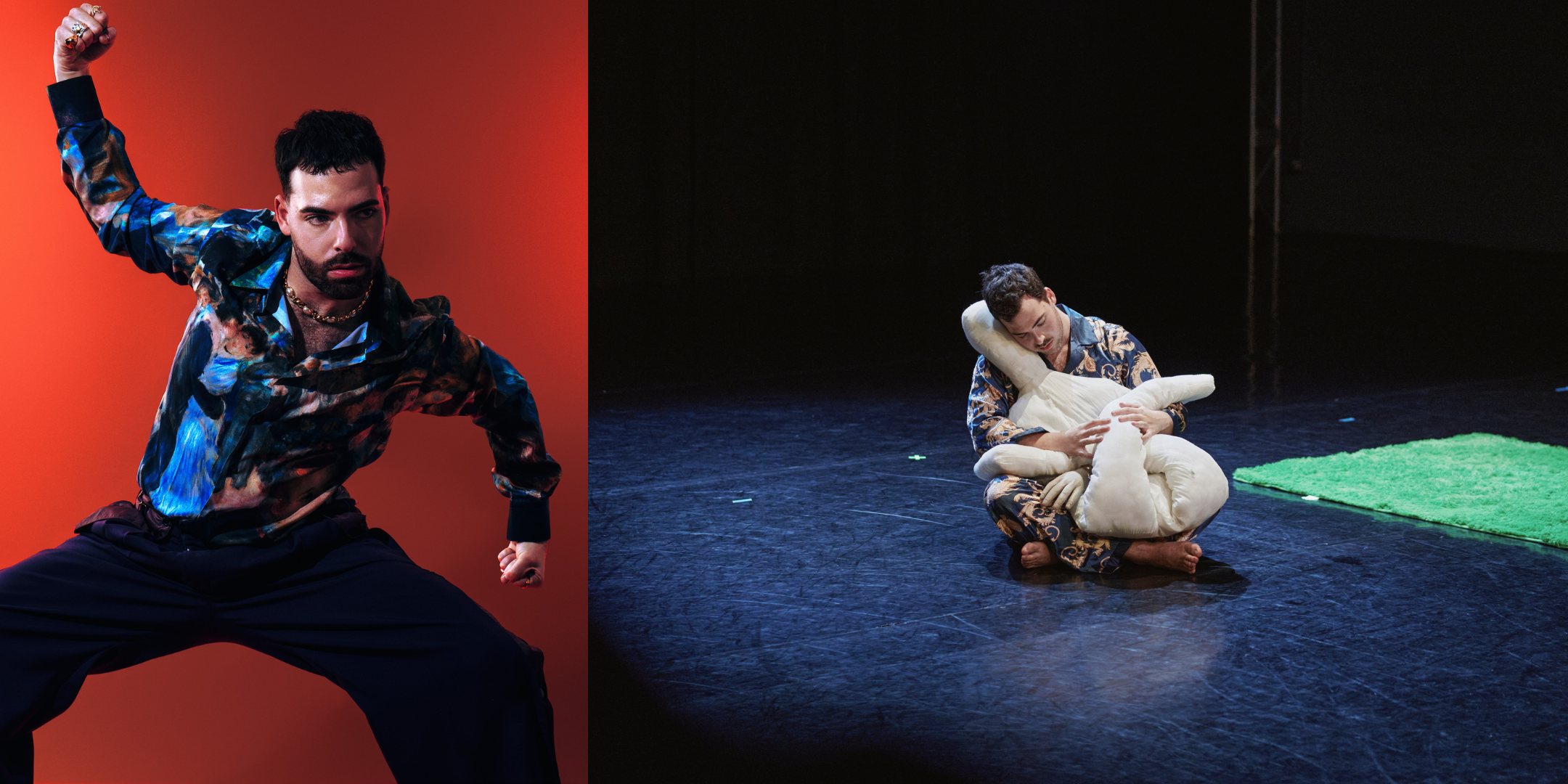
Brian Golden Redefines Disability Through Dance
Growing up, Brian Golden noticed certain differences that subtly set him apart. Tying his shoes, riding a bike, and petting a dog—things that seemed to require easy motor coordination—weren’t simple for him. He was placed in occupational and speech therapy, but he always felt he was teetering on the cusp, masking his struggles to appear “normal.” “I was surfing by in school, still struggling, but not enough to have something done about it,” he says.
When Golden was 14, he pivoted from fencing to dance. In class, he connected his mind and body, practicing complex motor skills and linking them to music. But even early on, Golden preferred improvisation to learning choreography. Connecting movements and reversing exercises from right to left was never his strong suit. “I was a fighter,” he admits, “and I wanted to keep going and dive into my own artistry.”
Growing up in Huntington Beach, California, Golden attended the Huntington Beach Academy for the Performing Arts for high school, focusing on dance. He later earned his BFA in dance from Chapman University. Graduating in 2021, Golden underwent disability testing and was diagnosed with dyspraxia, a neurodevelopmental condition affecting fine and gross motor coordination, as well as an auditory processing disorder.
Golden continued on his path as a choreographer, using his diagnosis as a catalyst to create work that speaks to his experience. He is now finishing his MFA in choreography at the California Institute of the Arts (CalArts).
Dance Teacher spoke with Golden to discover how he embraced his neurodivergence to shape his emerging choreographic career.
Transition to Choreography
“I say choreography is the act of proving my body and my brain matter, because for a long time, it didn’t feel like that. I choreographed in high school, but it wasn’t until my sophomore year at Chapman that I made my first real piece. Before, I was just making up moves to music. Here, I was in charge of the story and what I wanted to say. That summer, the piece won third place at the New Century Dance Project, and I decided I wanted to be a choreographer. I had to kiss dance goodbye, which was really sad. I fought hard, but I was injured, in pain, and struggled to remember choreography. Being surrounded by amazing dancers, I realized I couldn’t keep up. I had to let it go. But I was happy diving into choreography because my performers are translating my concepts and physical aesthetics through their bodies.”
On Grad School
“I originally didn’t want to apply to grad school. I thought I would wait, have a career, then go back. But I was constantly choreographing and realized I was repeating myself, with my habits always bleeding through.
“The first day of school, a professor said, ‘You came to an MFA because you’re lacking something.’ That resonated with me, and I asked myself what I was searching for…
What I love about CalArts is the collaboration. In every class, you might sit with a set designer, painter, or creative writer. It feels like the Olympics of art. You can also take classes in other art forms, which have expanded my practice the most.
“I’ve taken theater and playwriting classes, and now I’m creating sculptures. It feels like starting over, but I’m bringing all this knowledge with me. Recently, I’ve been thinking about sculpture in relation to my choreographic process. I use a lot of props in my work, often working with object-based performance, and now my sculpture practice is informing my choreography.”
Current Artistic Practice and Projects
“I finished Dance Lab New York in January, which was amazing. I worked with 12 incredible dancers. We worked five days a week for four hours, with the showing on Friday, so four days of making the work and one day to put it together. It was magical. The cast included disabled and nondisbled dancers.
“We also worked with a fully integrated cast of performers who are neurodivergent, deaf, limb different, and nondisabled. We started each day by sharing our access needs as a group, and practicing care and understanding within a rigorous working environment.
“At Q&As, people sometimes ask if it is a cast of disabled performers, and I find that confusing. Because would you ask, ‘Is this a cast of queer performers?’ or ‘Is this a cast of any specific race?’
“Now, I say I work with diverse performers, because everyone has different minds and bodies. I am interested in how disability is shaped not just by the body, but by the environments we move through. When spaces are more accessible and open, it can shift how disability is experienced. It becomes less about limitation and more about difference.
“In Dance Lab, I brought in poems and sketches I’ve been exploring. I’ve been writing poetry and making sketches out of shoelaces. Everything traces back to shoelaces because tying mine was difficult growing up, and I carried a lot of shame about it.
“The poems and sketches stem from my experience as a disabled individual, and we explored them together in the process, making choreography inspired by them, then manipulating the phrases.”