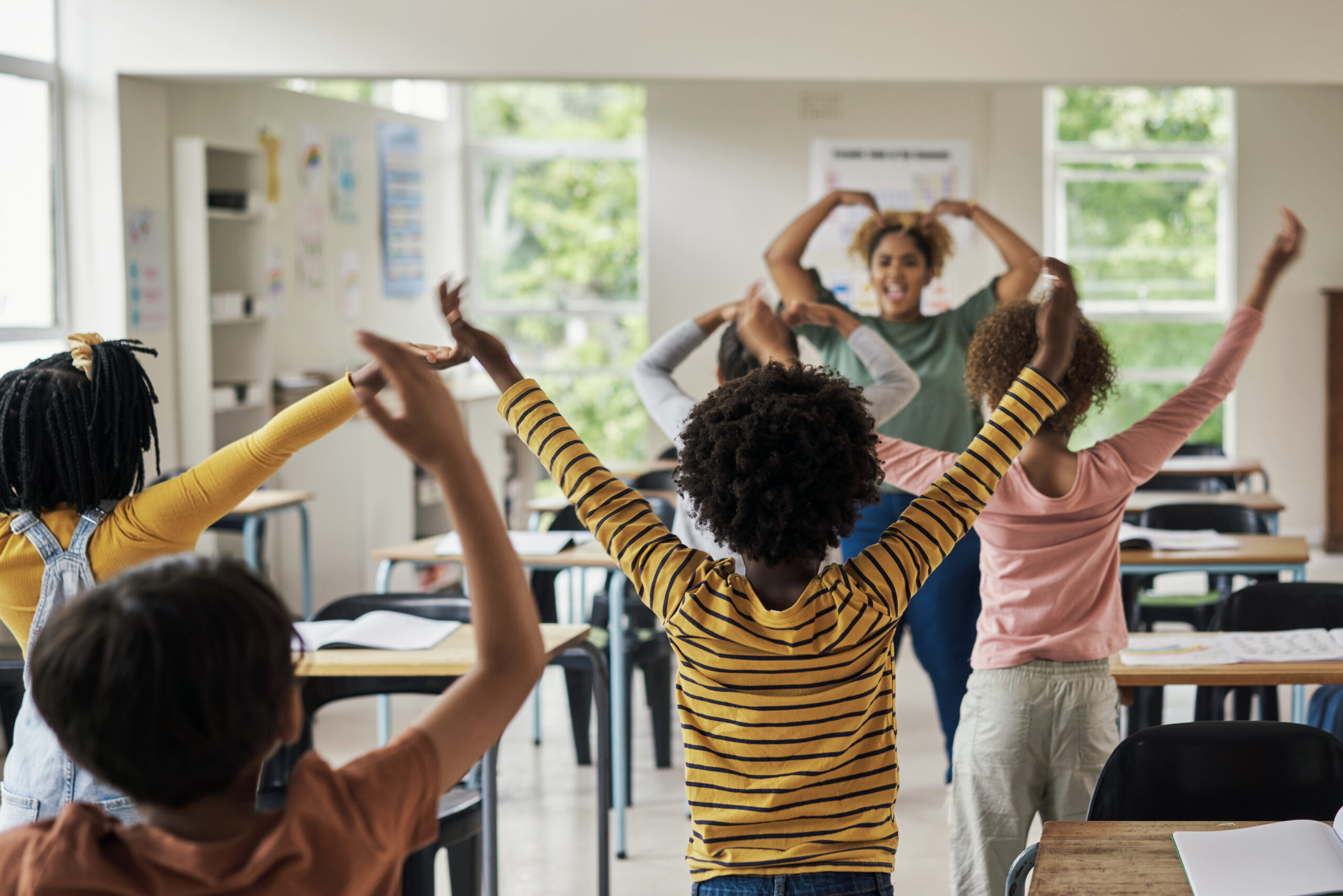
No Studio? No Problem: Teaching K–12 Dance in Any Setting

Every dance teacher dreams of a spacious, clean studio. But for many educators—particularly those in K–12 schools—the reality is teaching in shared, multipurpose spaces, adapting to frequent room changes throughout the school year to accommodate assemblies, indoor lunches, and other school events.
While you can’t always control your teaching environment, you can control how you adapt to it. As I reflect on my own teaching memories from the past 30 years, I remember leading K–12 dance classes outdoors because the multipurpose room was occupied. I adapted artist-in-residence lessons to classrooms, reconfiguring desks and available space (my first foray into site-specific work!), and even befriended a school librarian, who let me rearrange tables and book displays in her “sacred space.”
Recently, I spoke with five K–12 educators to discover how preparation, agility, creativity, communication, and team-mindedness can help teachers thrive in less-than-ideal teaching spaces. So whether you’re teaching in a gym, cafeteria, classroom, or auditorium, use these strategies to prepare with confidence for the school year ahead.
Get Creative With the Space
“Being adaptable is part of being an effective dance educator,” says Shawn Hawkins, a San Francisco Bay Area teacher at Elmhurst United Middle School in Oakland, California. “Every space offers a different teaching opportunity, and students feed off the teacher’s attitude, so if I stay flexible and positive, they usually do too.”
Courtney McCuen, who has taught K–5 classes for 15 years in Vancouver, Washington, agrees. “You need to get creative to figure out how to use the new space, especially if it is small or less than ideal,” she says. McCuen also brings students into the process, inviting them to help problem-solve. “The kids tend to have tons of interesting ideas about how to adjust and are very flexible. They love having their ideas and solutions utilized. For me, the kids help me keep a positive mindset about it.
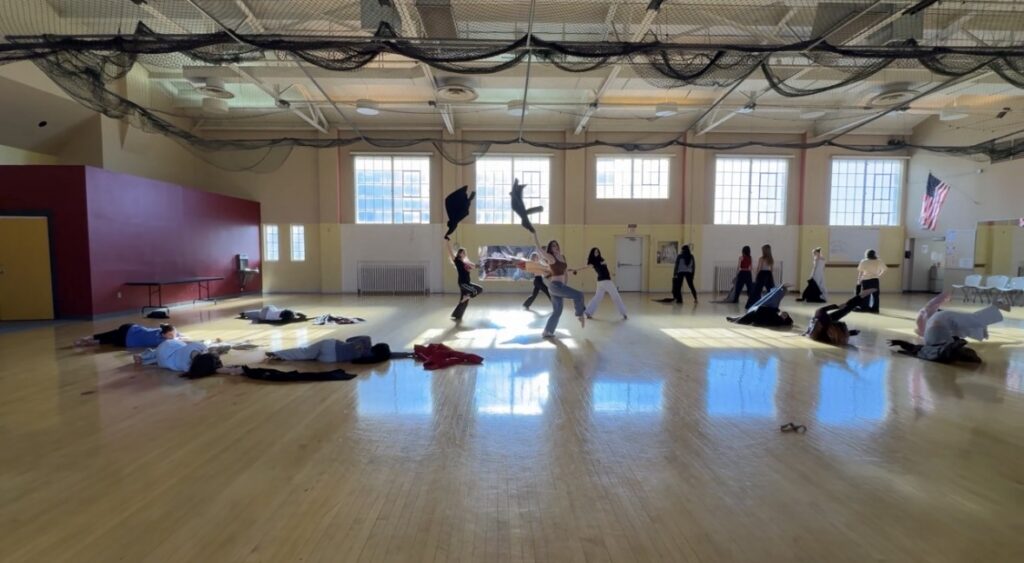
A temporary change in space often calls for temporary changes in your approach. Will students keep their shoes on or take them off? Do you need a portable sound system? Can you use cones, blue tape, or portable walls to establish boundaries? Safety, sound, and footwear are all important considerations—but so is the lesson itself. Decide what can be adapted and what might be better replaced with an activity that suits the new environment, while maintaining a through-line to the original lesson’s theme or dance concepts. Be sure to also have a portable tool kit at the ready, such as props, a portable speaker, supportive sneakers, and large reusable bags for transporting supplies.
Videos can also help your students see the possibilities of dancing beyond the studio. Look for dance films featuring artists working in a range of spaces, from parks and streets to classrooms and unconventional performance venues. You can also reach out to local dance film festivals to see if they have films to share.
Choreograph the Classroom
Your new “stage” may come with desks, chairs, and other classroom fixtures. Start by deciding: Will you work around the furniture, or choreograph the process of moving it? Oakland-based dance educator, Valerie Gutwirth, emphasizes the importance of establishing clear routines for either approach.
“You can move the furniture, but you [first] need a ritual for that,” she says. She recommends beginning with a calming breath and taking a good look at the room. Then, rather than simply telling students “Move your desks,” give specific directions about which group moves which items and where they should go. Move one group at a time, with students joining a circle in a preset place in the room between tasks. Once the space is cleared, Gutwirth suggests, celebrate the accomplishment with a quick high-five circle followed by a group activity that allows students to explore the room’s boundaries; for instance, tiptoeing to the edge or running toward it and stopping as if they’ve hit a force field.
Once you’ve established your space, let the classroom itself inspire the movement. Try chair dances, body percussion, found sound, or movement that incorporates tables and other furniture. In smaller spaces, explore jumps, stretches, turns, weaving, and walking, along with different levels, tempos, shapes, and rhythms. Classroom spaces can also be especially useful for exploring spatial relationships, mirroring, and follow-the-leader activities.
Look beyond the furniture, too. Whiteboards, chart paper and markers, books, and even a classroom’s reading corner can become part of the dance experience. The goal isn’t to re-create the studio—it’s to discover what the classroom makes possible.
Dance in the Great Outdoors
Teaching outside can require particular considerations for protecting the teaching voice. “I protect my voice by using concise directions, demonstrations, and student leaders instead of constantly projecting,” says Hawkins. “I use portable speakers when possible and clearly mark boundaries with cones, lines, or landmarks before class begins.”
Outdoor classes may also require advance communication with students and families about appropriate footwear and clothing for the weather. A whistle or an instrument can help capture students’ attention, while painted playground lines, circles, and numbers can become built-in pathways and spatial cues.
Take advantage of the big, open space and explore traveling movements such as skipping, grapevine steps, jogging, kicking, and jumping. Turn that big circle on the playground into a circle dance or explore other formations. And remember to befriend the PE teacher—you may be able to borrow cones, poly spot markers, scooters, hula hoops.
Navigate Shared Spaces
Lehua Estrada, a dance teacher at Judge Memorial Catholic High School in Salt Lake City, Utah, notes that “the facilitation of timely, generous, and detailed communication will likely fall on you and your colleagues without much enforcement from administration.” This means that you’ll likely need to take the lead on scheduling, negotiating, and managing expectations.
What has helped Estrada most in this scenario is having a good understanding of her school’s academic policies, which reinforces her need to keep the studio available within contract hours for students’ needs. “Dance courses take priority during contract hours,” she says, “and this is a time I can hold [other] clubs from taking over my space.”
Find Your Allies
Building relationships with the people who keep your school running—secretaries, custodians, lunch supervisors, recess supervisors, administrators, and fellow teachers—can make navigating shared and changing spaces much easier. These colleagues can also become valuable allies in supporting you and your students.
“Expect that your teaching space may change often, and don’t let that change your passion for teaching,” says Hawkins. “Build positive relationships because teamwork makes shared spaces much easier to navigate. Your flexibility will become one of your greatest strengths as an educator.”
J.C. Burnett-Gordon, who was a K–12 dance educator for 14 years and is now an assistant professor of dance and dance education at the University of Tennessee at Martin, offers a reminder worth carrying into any space. “I’ve taught dance everywhere from cafeterias and classrooms to hallways and libraries,” he says. “Those experiences remind me that dance isn’t defined by a studio; it’s defined by the learning that happens within the space. Every environment offers opportunities to build creativity, adaptability, and community.”