


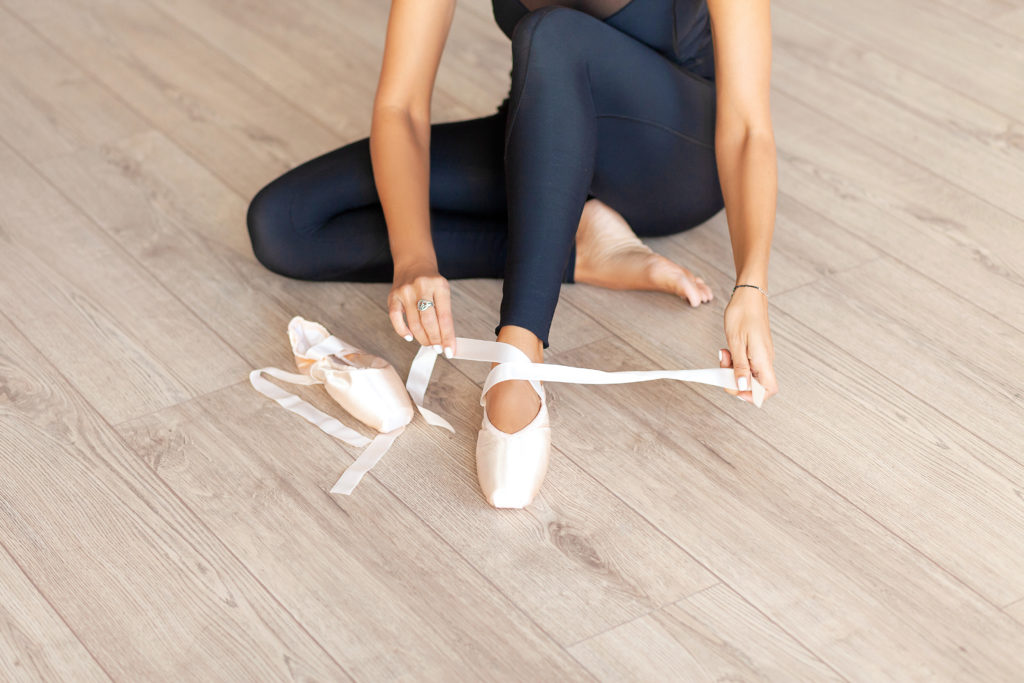
Pointework is often considered the pinnacle of ballet training and a fundamental part of our modern ballet culture. If you have adult dancers working hard in class, it’s natural for them to aspire to pointe. And while technique requirements are the same for ballet students of any age, beginning the pointe journey as an adult presents unique challenges.
Read on for more information about what some of those challenges are, as well as tips and exercises for how you can help your adult dance students start off strong.
Strength Requirements
Most adults starting pointework will need more strength than their younger counterparts. Here are some of the reasons why:
Increased body weight
A healthy adult will weigh more than a young girl! Pointework increases the force transferred through the foot by up to 12 times the body weight. Adult dancers need sufficient strength to support this extra force to prevent injuries.
Foot and ankle mobility
To ensure proper alignment, pointework requires significant foot and ankle flexibility. Younger dancers often develop this flexibility by gently elongating the soft tissues while their bodies are growing. Once soft tissues mature, improving pliability can be very difficult. Many adults will be able to achieve good foot and ankle flexibility with regular strengthening and mobility work. However, for some it may be impossible to achieve a fully pointed foot. Attempting pointe without sufficient flexibility may increase injury risk.
If your adult students only have minor limitations, they may still be able to learn pointe. However, they will need to develop extra strength and advanced neuromuscular motor control to ensure they can work their muscles and joints properly, within their limitations. For example, dancers with less flexible feet and ankles commonly sickle when trying to increase their pointe range. However, this adjustment can quickly lead to ankle sprains. Rather than trying to push adult students beyond what their joints and soft tissues will allow, focus on increasing the strength and control within the range they have.
Try this exercise with them to super-charge their foot strength and control:
- Sitting down with your legs in front of you, fully point your ankles and feet as much as you can, making sure you lengthen the toes.
- Maintaining the pointed ankle position, flex just your big toe up. Lengthen your big toe again, and lift just your little toes.
- Keep swapping big toe, little toes for 8–10 reps.

Previous injuries
Pointework is notorious for exacerbating preexisting aches, pains and injuries. A good defense strategy is to identify injury-prone parts of your students’ bodies. Then, create a strength-training plan that focuses on supporting these vulnerable structures. For example, knee pain in dancers is commonly caused by hip instability. Single-leg squats are a great way to build high-level strength and control in the hips.
Even if your students don’t have knee pain, perfecting a single-leg squat will seriously elevate their lower limb strength in preparation for pointework.
Try this:
- Stand on one leg in front of a chair, hips and legs in parallel.
- Slowly lower all the way to sitting. Then, push back up to standing. Keep your hips level and square throughout.
- Aim for 10 reps. You can make the exercise easier by raising the level of the chair using cushions or books.
- As your students get stronger, remove the cushions.

Increased risk of tendon injuries
As we get older, the collagen and elastin fibers that make up our tendons lose their elasticity. The individual fibers, rather than lying in neat, straight lines, can also become disorganized. These factors increase the propensity for irritation, micro-tearing and even full-blown tears. In ballet dancers, the Achilles tendon and the flexor hallucis longus tendon (which points the big toe) are particularly at risk due to stresses put on them from repeatedly pointing the foot and ankle.
The stronger the muscle–tendon unit is, the more resilience it has. Weighted calf raises are one of the best exercises for this job.
Try this:
- Grab a backpack and load it with a few heavy books.
- Stand in parallel on one foot, lightly holding on to a barre.
- Rise up onto demi-pointe, making sure you keep your ankle perfectly aligned. Build up to 20 reps on each leg.
- As your students get stronger, add more books!

The Benefits of Starting Pointe Later
Waiting until later to start pointe does come with benefits. Because adult bones are fully hardened and growth plates are fused, there’s less risk of foot deformity and serious fractures. Unless your adult students have hypermobility, there is minimal risk of stretching the ligaments, which could lead to unstable, painful joints in the feet and ankles. And, of course, all ballet lovers know that nothing beats the physical and emotional benefits of attending class and working hard!
The most important question your students should ask themselves is not “Am I too old?”, but rather “Am I ready?” Pointework is challenging at any age and should not be taken lightly. However, adults often come to ballet with the determination and focus needed to succeed. Remember: Your students are never too old to start pointe if you ensure that they have the proper training to do it safely.