How I teach jazz
Sheila Barker and Alix Beamon
Sheila Barker is not one to stand at the front of the room and talk to her students through the mirror. During her intermediate jazz class at Broadway Dance Center in New York City, it’s nearly impossible to keep tabs on her—she bounces around the studio, weaving around students to give corrections and lead exercises. “The people who stand in the back are just as important as the people in the front,” she says. “I’m a hands-on teacher. Everyone came to class to learn from me, and it’s my job to connect to each dancer and give them my attention.”
Classes at BDC are open and mixed-level, and although some students may technically lag behind others, “if they’re really going for it, I can push them for more,” Barker says. But as much energy as she gives to students, Barker demands their commitment and presence in return. “The magic is the gel between us: I’m giving them information, and beginning with the warm-up, I need them to be engaged.”
Barker’s strong and funky movement style reflects both her work with jazz legend Frank Hatchett and her classical modern background. Her in-class phrases are grounded and dynamic, full of rounded contractions, quick footwork and deep pliés. They require muscular elasticity and syncopation, which she helps dancers gain through stretching and strength building. While Barker’s combinations fly across the floor, it’s her careful and intense warm-up that’s paramount to her technique.
“The warm-up is a big deal,” Barker says. For students, it wakes up their senses so they’re aware of what their bodies are capable of that day. And the fun part for Barker, she says, “I can really knock them over by the end of class. They can do anything because they’ve warmed up thoroughly.” The exact ingredients of Barker’s warm-up vary by class depending on the final combination: “It’s necessary to organize the beginning of class so it makes sense in the end,” she says. But regardless of arrangement, the 40-minute, nonstop sequence flows through a structure that combines ballet, modern and yoga, lengthening and strengthening dancers’ legs, backs and abdominal muscles.
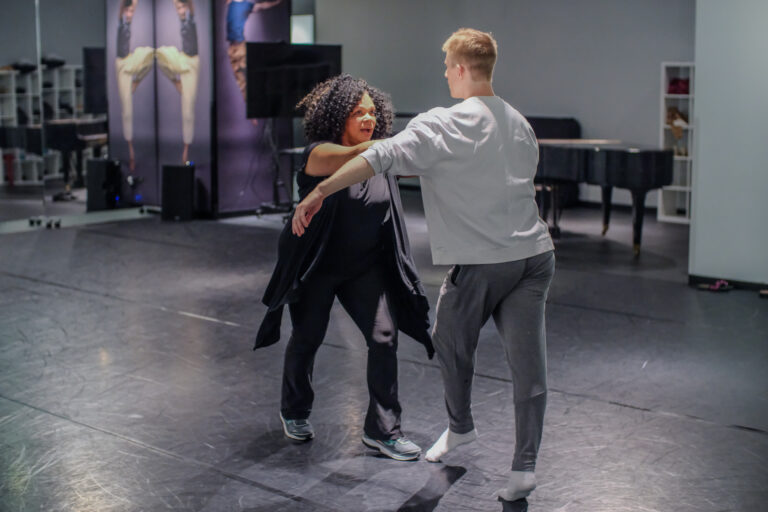
Here, Barker and student Alix Beamon demonstrate a portion of Barker’s warm-up that stretches a dancer’s hamstrings and calves, opens her hips and promotes core stability.
New Yorker Sheila Barker began dancing at the Harlem School of the Arts, training in ballet, modern and African. She received a BFA in dance from NYC’s City College, and after graduation she continued studying jazz with Frank Hatchett at his Hines & Hatchett studio in Manhattan. Barker became Hatchett’s teaching assistant and danced in Maurice Hines’ Tony Award–nominated production Uptown…It’s Hot! She has choreographed for music videos, commercials and stage shows, and in addition to leading classes at Broadway Dance Center, Barker is an adjunct professor of jazz at Marymount Manhattan College.
Alix Beamon studies with Sheila Barker. In May 2010, she completed a five-month internship at Broadway Dance Center while attending Fordham University in New York.
photo by Kyle Froman at Broadway Dance Center in New York