Follow Me on Pinterest Google Plus Page


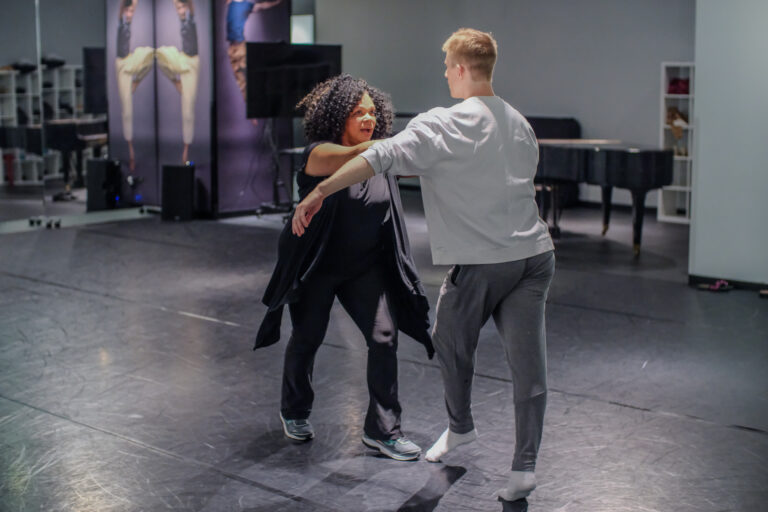
Mary Seidman spent a decade as artistic director of a children's dance school in NYC....
In our Technique video of the month, Michelle Dorrance. a former dancer in STOMP and...
Bess Kargman’s first glimpse of Youth America Grand Prix was by chance. On a walk through lower...
In 2011, NYC-based dancemaker Al Blackstone won Capezio's Award for Choreographic Excellence. His...
Master Dunham teacher Rachel Tavernier and student Dianna Anderson demonstrate a barre exercise...
Art of Motion hosts Luigi, assisted by Francis J. Roach, to teach a jazz master class at...

Technique: Ray Leeper

By jdalzell

How I teach jazz

Convention teacher for more than 20 years and longtime commercial choreographer, Ray Leeper has experienced plenty of choreographic trends, the latest being “contemporary.” A composite of many dance disciplines, contemporary is everywhere, practiced at conventions and popularized by television. And although contemporary classes are often the most coveted by students at conventions, Leeper prefers to stick to strictly jazz when teaching. “A lot of the professional work out there has nothing to do with contemporary,” he says, noting that none of the commercials he’s worked on featured this quirky style. Instead, what students need for successful careers, Leeper says, is an understanding of how fastidious ballet training truly correlates with jazz.
 
“We all say ad nauseam how important ballet training is,” he says. “But we’re not communicating to the kids exactly why they should be in ballet class, and how it applies to jazz. We need to spell it out for them.” Leeper often highlights a student who performed a phrase well and then discusses with other dancers why his or her movement was so successful. “I ask them, ‘Why are you so engaged in what this person is doing?’” he says. “And when we break it down, they see it’s almost always because that dancer is in control and engaging her technique: She’s holding her core, her rib cage is closed and she’s pulling up, out of her hips.”
 
Leeper’s classes are structured classically. He starts with a long warm-up of center work that follows the organization of a ballet barre. “It gives everyone a chance to get on their legs and in touch with their bodies,” he says. Then Leeper teaches long across-the-floor combinations that, although containing basic steps, are highly stylized. “In the real world, choreography is mixed with technical aspects,” he says. “At an advanced level, it does no good to just practice piqués across the floor. You’d never do that in a professional setting.” Students are forced to apply the technical concepts they work on at the beginning of class—standing in correct alignment, engaging their inner thighs and keeping their hips and shoulders square.
 
“Kids will throw themselves into shapes they think look good, instead of thinking about lengthening or making sure their pelvises don’t tilt,” Leeper says. “If you explain stylized movements from a technical base, dancers can look really great. Someone just has to help them connect the dots.”
 
Here, Leeper and dancer Daniella Cavaleri demonstrate three stylized jazz positions that can be traced back to their ballet roots—second position grand plié, tendu en avant and retiré. 
————————————
 
A Los Angeles native, Ray Leeper started dance training after playing the role of The Artful Dodger in an elementary school production of Oliver. At 17, he began seriously studying jazz with Joe Tremaine and just two years later was teaching for Tremaine’s convention. Leeper has also taught for JUMP/Break the Floor and Broadway Dance Center, and he is currently the executive director of NUVO Dance Convention. He credits his comprehensive ballet training to L.A.-based ballet teacher Paula Morgan. Leeper’s off-Broadway and stage credits include the Il Divo World Tour, Franco Dragone’s INDIA and ONE LOVE in Las Vegas and Matthew Morrison’s 2011 promotional tour. He’s choreographed TV shows, including “So You Think You Can Dance” and “The Big Bang Theory,” and commercials for Pepsi and Sierra Mist, and he has worked with Cher and Elton John.
 
New Yorker Daniella Cavaleri is a teacher and choreographer for competition studios in the area. She performed on the national and international tours of Fosse, and she was a swing for the Radio City Christmas shows.
 
—————————————
 
Deep lunge and backbend
 
The key to this deep lunge and backbend is keeping your hips square and pelvis straight.
 
Step 1: Start in a second position grand plié. Your pelvis is flat and your rotators are engaged. Your shoulders are down and elbows lifted.
 
Step 2: Move your arms to first position, and turn your body to the left, so your right leg turns in. Your pelvis should not tilt forward (swaying your lower back), and your hips should be square to the front. Keep your core engaged and your inner thighs working.
 
Step 3: Maintaining the shape of your lower body, twist only your upper torso to face front. Keep your lats engaged (just as they are in first position) as you move your left hand to your upper rib cage. Drop your right arm to rest on your calf and think of ballet class épaulement as you lean your head back, keeping your chin down.
 
Sliding tendu hinge
 
This hinged position engages the rotators, hamstrings and lower abdominals.
 
Step 1: Begin by brushing your right foot through the floor to a tendu en avant. You are actively rotating your thighs and your arms are held in a strong first position.
 
Step 2: Plié on your left standing leg, and allow your right leg to slide forward depending on the depth of your plié. Don’t release your turnout. Keep your lower abdominals connected as you hinge your torso to form a straight line from your right leg to your shoulders.
 
Step 3: Without releasing your lats, move only your lower arm to grab your upper ribs. Think of the two sides of your rib cage zipping together as you press your elbows forward. Do not release your lower abdominals to keep space in your lumbar spine during the hinge. And just as in the initial tendu, your right toe should hold no weight.
 
Flick (with relevé)
 
This feminine flicked shape should look effortless and weightless—even though your hamstrings and inner thighs are working like crazy.
 
Step 1: Begin by drawing your right foot to retiré by engaging your hamstrings and rotator muscles. Keep your right hip down, and pull up out of your standing leg so you’re not sitting in your left hip joint. Your arms are in first position.
 
Step 2: Keeping your right hip down and leg turned out, engage your inner thighs and move your right knee forward to a parallel position. Keep your stomach muscles lifted.
 
Step 3: Drop your right knee to meet your left. You should feel your right hamstring greatly contracted, and make sure to keep your inner thighs actively connected.
 
Step 4: Lower your right arm to meet your leg and lift your left in opposition. Pull up even higher on your standing leg to relevé, just as you would if you were still in the initial retiré. Be sure to really hold your abdominals and inner thighs—the keys to balancing.
 
Note: Keep your stomach muscles lifted and connected so your lower back does not sway. If your inner thighs are not actively engaged, your legs will separate and the position will not be easily held in relevé.
 
Click here to see a video breakdown of these steps!
 
(photo by Matthew Murphy)

Supplements

Studio Talk - April Edition
Dance Directory 2010
Role Models Past and Present
Beyond Performance
Lifetime Learners
Secrets of a Successful Studio